AI estimate as of September 12, 2025 · verify with a professional before acting
AI-Generated · Verify before acting
Everything on this page is generated by AI for informational purposes only. AI can make mistakes — the AI may misidentify items or misattribute them (artist, maker, brand, designer, origin, era). This is not an official valuation and should not be used for insurance, sale, tax, estate, legal, or lending purposes — or any decision requiring a certified appraisal. It is not an authoritative claim about any person, brand, or rights holder — do not share or rely on it as a factual statement about a third party. Always consult qualified professionals before making financial decisions.
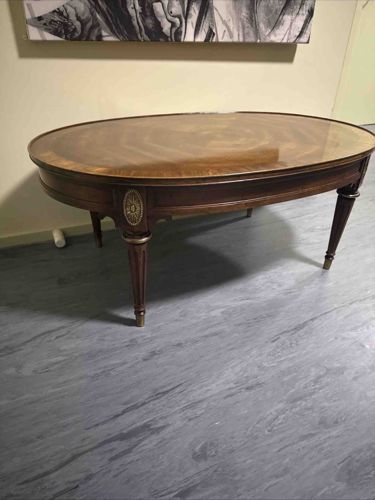
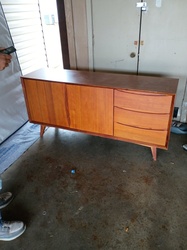
This is an oval coffee table exhibiting characteristics of the Neoclassical style. The tabletop appears to be constructed from wood with a central lighter-toned inlay, likely veneer, showcasing a radiating or concentric pattern that adds visual depth and sophistication. The edges of the tabletop feature a contrasting darker wood border, creating a framed effect. The table base is made of dark-stained wood, possibly mahogany or a similar hardwood, with a consistent rich brown hue. The shape is an elongated oval, providing a generous surface area.
Each of the four tapering legs is fluted, a common decorative element in Neoclassical design, and terminates in a brass or bronze sabot or foot cap, which shows some signs of patina or light wear appropriate for its age. A particularly notable feature is the brass or bronze medallion situated on the apron of the table, centered on one of the long sides. This medallion is oval-shaped and features an intricate classical motif, possibly a sunburst or a stylized wreath, which is typical of the period's emphasis on classical antiquity.
The overall condition appears good, with a visible, albeit faint, layer of dust or surface grime on the tabletop, suggesting it has been in use. There are no immediately apparent significant damages such as deep scratches, cracks, or chips, though a full assessment would require closer inspection. The finish on the wood seems generally well-preserved, though some minor scuffs or wear consistent with age and use might be present upon detailed examination. The craftsmanship quality appears high, indicated by the detailed inlay work, the fluted legs, and the ornamental hardware, suggesting a well-made furnishing. Estimated age would likely place it in the late 19th to early 20th century, or a more modern reproduction crafted in the Neoclassical style.
AI Appraisal Report
Upon visual examination of this Neoclassical Style Oval Coffee Table, I assess its overall condition as good, consistent with an item of its likely age. The central lighter-toned inlay, bordered by a darker wood, presents an appealing aesthetic. The fluted legs and brass/bronze sabot feet exhibit appropriate wear, suggesting authenticity rather than newness. The most striking 'Neoclassical' characteristic is the oval brass/bronze medallion on the apron, featuring a classical motif, which enhances its decorative appeal.
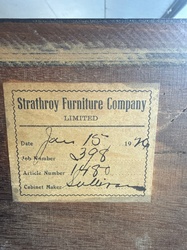
Authenticator verification is limited by visual assessment alone. While the craftsmanship, patina on metalwork, and general style suggest a period piece (late 19th to early 20th century) or a high-quality reproduction, definitive authentication would require in-person examination to check joinery, wood types, and finish application, which can reveal modern manufacturing techniques. Provenance documentation, such as original sales receipts or family history, would further solidify its age and origin. Scientific testing of materials, though usually reserved for very high-value pieces, could confirm wood and metal composition.
In terms of market conditions, Neoclassical style furniture generally maintains steady demand. Pieces with distinctive features like this table's detailed inlay, fluted legs, and classical hardware tend to fare better. While not exceedingly rare, the quality of craftsmanship positions it above mass-produced items. Value is primarily driven by its aesthetic appeal, functional form, and perceived authenticity. The signs of use, such as the faint dust, are normal and do not detract from its value; conversely, they suggest it is a functional and appreciated piece. If confirmed as an antique, its value would lean towards the higher end of my estimate; otherwise, as a high-quality reproduction, it would be at the mid-to-lower range.