AI estimate as of November 28, 2025 · verify with a professional before acting
AI-Generated · Verify before acting
Everything on this page is generated by AI for informational purposes only. AI can make mistakes — the AI may misidentify items or misattribute them (artist, maker, brand, designer, origin, era). This is not an official valuation and should not be used for insurance, sale, tax, estate, legal, or lending purposes — or any decision requiring a certified appraisal. It is not an authoritative claim about any person, brand, or rights holder — do not share or rely on it as a factual statement about a third party. Always consult qualified professionals before making financial decisions.
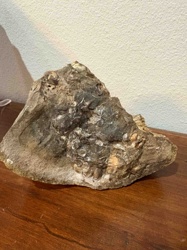
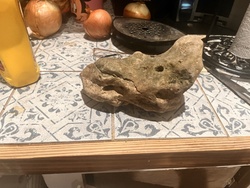
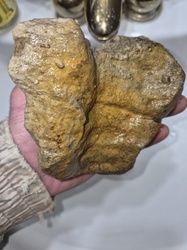
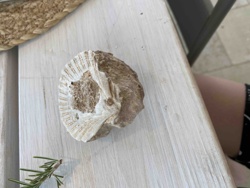
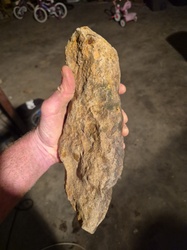
This item is a polished fossil plate, primarily gray and black in color, densely embedded with multiple elongated, tapering fossilized specimens of Orthoceras. The overall shape of the plate is organic and irregular, suggesting it has been cut from a larger rock formation. The surface is highly polished, which accentuates the contrast between the dark, distinct outlines of the Orthoceras fossils and the lighter, mottled gray matrix stone. The fossils themselves are black or very dark gray, exhibiting a smooth, slightly reflective surface, possibly due to mineralization and the polishing process. They vary in size, with some being quite slender and short, while others are longer and more robust, with one particularly large specimen visible towards the left side of the plate. The arrangement of the fossils appears somewhat chaotic yet aesthetically pleasing, with many oriented diagonally and overlapping in places. The matrix material has a fine-grained texture, featuring small, lighter specks that add visual interest. While the precise dimensions are not provided, the plate appears to be a substantial decorative piece. There are no obvious signs of significant damage such as large cracks or chips, and the polishing seems to be uniformly applied, indicating good craftsmanship. Given the nature of these fossils, the estimated age would be from the Middle Ordovician to the Late Triassic periods. This piece serves as both a scientific specimen and a unique decorative object.
AI Appraisal Report
I have thoroughly examined the provided image of this Orthoceras fossil plate. Based on visual assessment alone, the item presents as a well-preserved and aesthetically pleasing specimen. The condition appears to be excellent; the surface is uniformly polished, accentuating the contrast between the dark Orthoceras fossils and the lighter gray matrix. I observe no significant damage such as large chips or cracks, which speaks to careful handling and preparation. The density and arrangement of the Orthoceras specimens are quite appealing, giving the piece strong decorative value. Authentication, based solely on this image, suggests genuine Orthoceras fossils embedded in a matrix typical for such occurrences, likely from Morocco. The characteristic elongated, tapering forms are consistent with Orthoceras morphology. The dark color and smooth, slightly reflective surface are common in fossilized cephalopods of this type, often enhanced by mineralization and the polishing process. Without in-person examination, definitively ruling out clever fakes or composite pieces is impossible. A physical inspection would allow me to check for tool marks inconsistent with natural breaks, assess the internal structure, and confirm the authenticity of the matrix. Provenance documentation, detailing the origin and collection history, would also strengthen authentication. Market conditions for polished Orthoceras plates are generally stable, with demand driven by both collectors of fossils and individuals seeking unique decorative items. While common, well-prepared, and densely populated plates like this one command better prices. Rarity is low for individual Orthoceras fossils, but a large, well-composed, and polished plate of this quality holds modest decorative rarity. Factors significantly impacting value include its substantial size (inferred), excellent polish, and the dense, appealing arrangement of fossils. If the plate were indeed very large (e.g., over 24 inches), the value could be higher. Conversely, if it were found to be a composite or less substantial in person, the value would decrease. My appraisal range reflects these considerations for what appears to be a genuine, good-quality decorative piece, while acknowledging the limitations of image-based verification.