AI estimate as of October 28, 2025 · verify with a professional before acting
AI-Generated · Verify before acting
Everything on this page is generated by AI for informational purposes only. AI can make mistakes — the AI may misidentify items or misattribute them (artist, maker, brand, designer, origin, era). This is not an official valuation and should not be used for insurance, sale, tax, estate, legal, or lending purposes — or any decision requiring a certified appraisal. It is not an authoritative claim about any person, brand, or rights holder — do not share or rely on it as a factual statement about a third party. Always consult qualified professionals before making financial decisions.
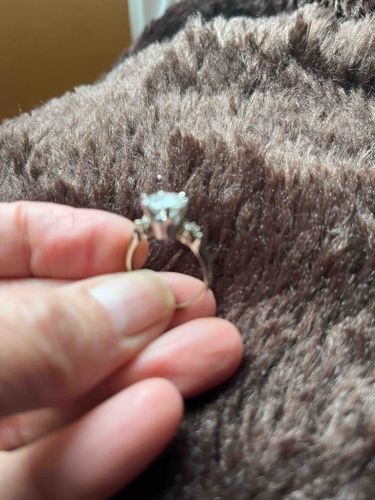
The item is a silver-toned engagement ring, likely crafted from white gold, platinum, or sterling silver, given its lustrous metallic appearance. The ring features a prominent, round brilliant-cut center stone, which appears to be a diamond or a diamond simulant, held securely by a traditional six-prong setting. The prongs are finely crafted and converge around the girdle of the center stone, allowing maximum light exposure. The central stone exhibits significant brilliance and sparkle, characteristic of well-cut gemstones. The shoulders of the ring's band are adorned with smaller, pave-set accent stones, extending partway down each side. These smaller stones add an additional layer of sparkle, enhancing the overall elegance of the piece. The band itself appears delicate yet strong, with a polished finish. While specific size cannot be determined from the image, the ring appears to be of standard engagement ring proportions. No visible condition issues such as chips, cracks, or significant abrasions are apparent on the stones or the metalwork, although a detailed inspection would be required to confirm this. The overall craftsmanship suggests a mass-produced but well-finished item, characteristic of contemporary fine jewelry design. There are no discernible maker's marks or signatures visible in the provided image. The style is timeless and classic, fitting into modern jewelry trends.
AI Appraisal Report
Based on my visual examination of the provided image, I assess this Round Brilliant Solitaire Engagement Ring with Pave Accents. The ring appears to be in excellent condition, with no visible chips, cracks, or significant abrasions on the stones or the metalwork, although a detailed in-person inspection would be needed to confirm this. The craftsmanship suggests a well-finished, mass-produced item. Authenticity of the center stone as a natural diamond, and the metal as white gold or platinum, cannot be definitively confirmed from images alone. The sparkle suggests a well-cut stone, but it could be a high-quality diamond simulant like moissanite or cubic zirconia. Similarly, the pave accents appear to be diamonds, but could be other white gemstones.
In terms of market conditions, solitaire engagement rings with pave accents are highly popular and consistently in demand. This classic design ensures a broad market appeal. Comparables for a natural diamond center stone (0.75-1.00 carat, G-I color, VS2-SI1 clarity) with diamond pave accents in 14k white gold typically range from $2,500 to $6,000. If the center stone were a high-quality diamond simulant and the metal sterling silver, the value would be significantly lower, potentially $300-$800. The current value range reflects the high probability of it being a natural diamond and precious metal based on its overall presentation and typical market offerings for this style.
Factors significantly impacting value are the exact composition and quality of the center stone (natural diamond vs. simulant, carat weight, color, clarity, cut), the material and purity of the metal (platinum, 14k/18k white gold vs. sterling silver), and the quality of the accent stones. Without in-person examination for precise gemological assessment, metal testing, and weight measurements, the exact authenticity and therefore the precise value cannot be determined. Provenance documentation, such as a GIA or equivalent grading report for the center stone, would also be crucial for full authentication and a more definitive appraisal.