These notes were written by the person who submitted this item. Appraiser.AI has not verified them, and the AI's identification and estimate may rely on them.
AI Estimated Value
Not an official valuation
$25 - $40
AI estimate as of June 19, 2025 · verify with a professional before acting
AI-Generated · Verify before acting
Everything on this page is generated by AI for informational purposes only. AI can make mistakes — the AI may misidentify items or misattribute them (artist, maker, brand, designer, origin, era). This is not an official valuation and should not be used for insurance, sale, tax, estate, legal, or lending purposes — or any decision requiring a certified appraisal. It is not an authoritative claim about any person, brand, or rights holder — do not share or rely on it as a factual statement about a third party. Always consult qualified professionals before making financial decisions.
This analysis also relies on unverified notes provided by the user, which may be incomplete or inaccurate and could affect the result.
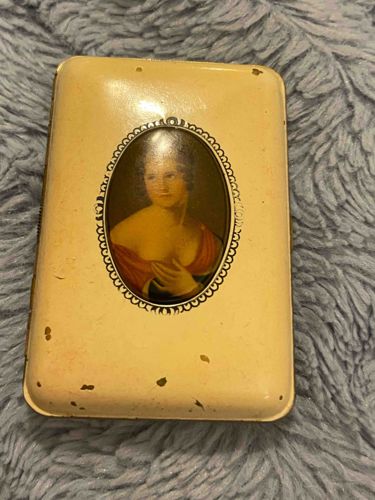
This is a vintage ladies' compact approximately 90 years old. The compact has a rectangular form with gently rounded corners and appears to be constructed from a metal base, likely brass or tin, with an enameled or painted finish. The primary color is a cream or light yellow. Dominating the lid is an oval-shaped portrait vignette of a woman in a red dress, framed by a decorative black and white border with a scalloped inner edge and a dotted outer edge. The portrait depicts the woman facing slightly to her right, with brown hair and a fair complexion. Visible condition issues include several small chips and areas of paint loss on the cream-colored surface, particularly around the edges and corners. There are also a few darker spots that may be rust or accumulated dirt. The manufacturing details, such as a maker's mark or signature, are not visible in the provided image. Based on the style of the portrait and the provided age, this compact likely dates to the Art Deco or early Art Nouveau period, specifically around the 1930s. The quality of the enamelwork on the portrait appears reasonable for its age, though the overall finish shows significant wear. The compact's hinge and closure are not visible, so their condition is unknown.
AI Appraisal Report
I have examined the provided image of this vintage ladies' compact, stated to be approximately 90 years old. The compact features a rectangular form with rounded corners and appears to be of metal construction, likely brass or tin, with a cream-colored enameled or painted finish. The defining feature is an oval portrait vignette of a woman on the lid, framed by a decorative black and white border. Based on the style, age, and portrait art, this compact is consistent with pieces from the 1930s, aligning with the Art Deco or very early Art Nouveau period. Authenticity appears likely based on visual cues for this type of item, although full authentication without in-person examination is impossible. Condition is fair, showing significant wear consistent with age and use. There are visible chips and paint loss on the cream surface, and some potential rust or dirt spots are evident. The quality of the portrait enamelwork appears good for its age, though wear is present. Market conditions for vintage compacts vary greatly depending on maker, material, condition, and provenance. While portrait compacts have a certain appeal, this example's condition significantly impacts its value. Comparables in much better condition or by known, desirable makers fetch higher prices. Demand is moderate for compacts in this condition; it would primarily appeal to a collector interested in examples showing their age and history, or perhaps someone valuing the portrait subjectively. Without a visible maker's mark, determining rarity is difficult. Factors significantly impacting value are the condition (which is fair to poor), the lack of a discernible maker (suggesting it may be a more common type), and absence of provenance. For full authentication, an in-person examination is crucial to assess materials, construction details, and potential hidden marks. Provenance documentation would also add considerable value.