AI Appraisal Estimate

AI-generated estimates · not official valuations

From the user

What was submitted

Photo and notes provided by the user — not generated by AI

Submitted item photo
Submitted photo · May 27, 2026

User's notes

No additional notes provided.

AI analysis below

AI appraisal

AI analysis & estimate

AI-Generated · Verify before acting

Everything below is generated by AI for informational purposes only. AI can make mistakes — the AI may misidentify items or misattribute them (artist, maker, brand, designer, origin, era). This is not an official valuation and should not be used for insurance, sale, tax, estate, legal, or lending purposes — or any decision requiring a certified appraisal. It is not an authoritative claim about any person, brand, or rights holder — do not share or rely on it as a factual statement about a third party. Always consult qualified professionals before making financial decisions.

Read the full disclaimer

AI Identification

·Not independently authenticated·Verify before acting

Bamileke style beaded zoomorphic bench

Furniture / African Tribal Art

AI Estimated Value

·Not an official valuation·Verify before acting

$1,200-$1,800

As of May 27, 2026

AI Item Analysis

·AI can make mistakes·Verify before acting
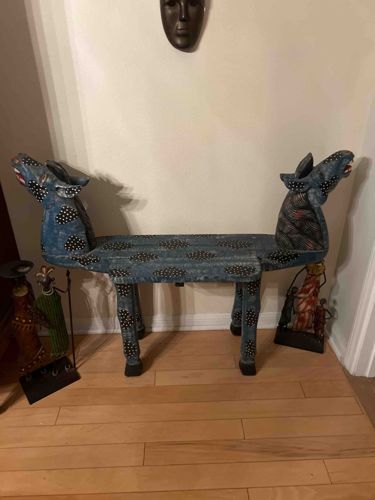
This is a hand-carved wooden bench featuring a distinctive zoomorphic design, likely influenced by West African Bamileke or Grassfields artistic traditions. The piece is constructed from a solid foundation of wood, completely and intricately covered in a vibrantly colored beadwork patterns. The bench displays a symmetrical composition with two upward-facing animal heads at either end, resembling stylized leopards, hyenas, or similar totemic creatures with bared teeth. The primary color is a saturated blue, overlaid with a pattern of white and black beaded clusters that create a 'spotted' or leopard-print effect. The bench is supported by four cylindrical legs, also fully beaded, terminating in dark, seemingly unbeaded feet. Physically, the bench appears to be of mid-to-large scale, suitable for ornamental use. The craftsmanship is highly detailed, with beads applied in a tight mesh or woven pattern over the wooden core. Condition-wise, the item shows some signs of age and handled wear; there are visible areas of surface dust and slight fading in the pigment of the beads, particularly along the seat, but it appears structurally sound. This style of furniture is often associated with prestige and tribal royalty, though this specific example displays characteristics of 20th-century decorative export craft.

AI Appraisal Report

·AI can make mistakes·Verify before acting
I have virtually examined this Bamileke-style zoomorphic beaded stool. The piece demonstrates characteristics of the Grassfields region of Cameroon, where such items—often referred to as 'prestige stools'—historically signified the status of the Fon (king) or high-ranking nobility. The craftsmanship features tight, multi-colored beadwork over a solid hand-carved wood core, with the leopard motif symbolizing power and authority. Based on the bead consistency and the visible wear on the seating surface and feet, I identify this as a mid-20th-century prestige piece. While it shows some dust accumulation and minor bead loss typical of age, the structural integrity remains excellent. The market for African tribal furniture remains robust, particularly for items with high decorative impact. Comparables for vetted vintage Bamileke stools of this scale regularly hammer between $1,000 and $2,500 at specialty auctions. The value is driven by the density of the beadwork and the symmetrical 'two-headed' zoomorphic design. However, there are limitations to this digital appraisal. From images alone, I cannot verify the specific wood species or the internal construction (tension of the mesh). A physical inspection is required to check for structural repairs hidden under the beads and to confirm if the beads are antique glass or modern plastic, which significantly impacts value. Furthermore, establishing a clear provenance or chain of ownership would be necessary to elevate this from a 'decorative export' to a 'collectible ethnographic artifact.' Scientific testing of the wood via radiocarbon dating could provide an absolute age but is generally reserved for high-value institutional pieces.

Get your items appraised

Instant estimates of your treasures with AI-powered appraisals

Browse More Appraisals