AI estimate as of November 15, 2025 · verify with a professional before acting
AI-Generated · Verify before acting
Everything on this page is generated by AI for informational purposes only. AI can make mistakes — the AI may misidentify items or misattribute them (artist, maker, brand, designer, origin, era). This is not an official valuation and should not be used for insurance, sale, tax, estate, legal, or lending purposes — or any decision requiring a certified appraisal. It is not an authoritative claim about any person, brand, or rights holder — do not share or rely on it as a factual statement about a third party. Always consult qualified professionals before making financial decisions.
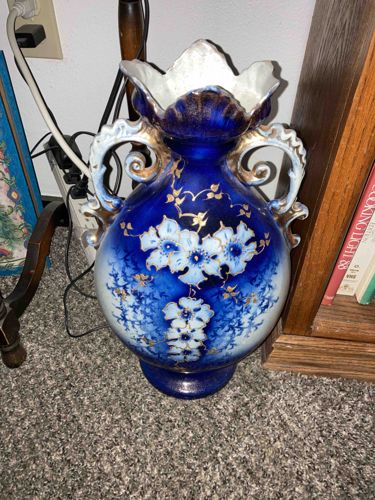
This is a large, ornate handled vase, likely dating to the late 19th or early 20th century, consistent with Victorian or Edwardian aesthetics. The vase features a bulbous body with a distinct cobalt blue glaze transitioning to a lighter blue and white at the base and in areas of the floral decoration. The dominant color is a rich, deep cobalt blue, which appears to be a foundation glaze. Over this, a sponge-like application or wash of lighter blue and white creates a cloud-like or watercolor effect, particularly around the stylized floral motifs. The floral designs themselves are rendered in white and lighter blue hues, possibly employing an enamel or raised slip technique, and are further embellished with intricate gilt detailing in the form of leaves, vines, and accent outlines. The handles are particularly decorative, scrolled and accented with gilt, emerging from the shoulder of the vase and curving upwards to meet the ruffled, scalloped rim. The rim itself appears to have a textured, possibly sponged or scumbled, white interior with gold accents. The base is circular and flares slightly, maintaining the deep cobalt blue. While no specific maker's marks are visible in the provided images, the craftsmanship suggests a mass-produced yet hand-decorated piece typical of the period. The overall condition appears fair, with some potential wear to the gilt, common for its age. There are no obvious chips or cracks, but a thorough in-hand inspection would be needed to confirm this. The vase exudes a sense of grandeur and ornamental flair, characteristic of the historical period it represents.
AI Appraisal Report
I have examined the provided image of this Victorian-style cobalt blue and white hand-painted handled vase. Visually, its design with a bulbous body, ornate scrolled handles, and stylized floral motifs with gilt accents is consistent with late 19th to early 20th-century Decorative Arts. The cobalt blue glaze transitioning to lighter blues and white, coupled with the hand-painted details, suggests a mass-produced yet hand-finished item, characteristic of the era.
Based on the image, the condition appears fair, showing typical wear commensurate with age, particularly to the gilt detailing. I do not observe any obvious chips or cracks, which is positive. The authenticity, based solely on visual cues, points to it being a period piece, though without a clear maker's mark, specific attribution is difficult. Many factories produced similar wares during this time.
The current market for such Victorian and Edwardian-period decorative vases is stable but not experiencing significant surges. Comparable pieces, particularly those without definitive maker's marks or significant historical provenance, typically fall into a moderate price range. Demand is from collectors and individuals seeking period decor, but it is not considered rare. Factors impacting value include the visible wear to the gilt, which is common but still a detractor, and the absence of a discernible artist or manufacturer, which limits its collectibility beyond general decorative appeal.
My valuation is based on these visual observations. For full authentication, an in-person examination would be crucial to assess surface integrity, detect any hidden repairs, and confirm the exact manufacturing techniques. Microscopic analysis of paint and glaze, and potentially UV light inspection, could also assist in verifying originality and absence of restoration. Research into potential maker's marks, if any are present but obscured, would also be beneficial.