AI estimate as of September 9, 2025 · verify with a professional before acting
AI-Generated · Verify before acting
Everything on this page is generated by AI for informational purposes only. AI can make mistakes — the AI may misidentify items or misattribute them (artist, maker, brand, designer, origin, era). This is not an official valuation and should not be used for insurance, sale, tax, estate, legal, or lending purposes — or any decision requiring a certified appraisal. It is not an authoritative claim about any person, brand, or rights holder — do not share or rely on it as a factual statement about a third party. Always consult qualified professionals before making financial decisions.
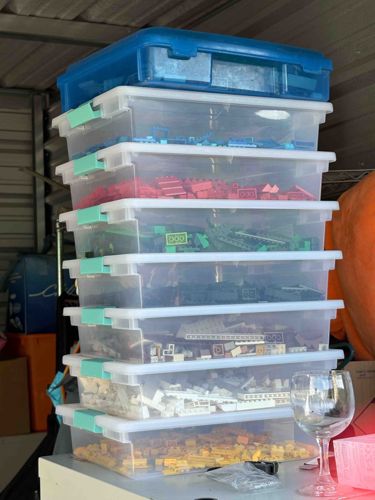
This item consists of a substantial collection of various LEGO bricks, organized and stored within a stack of seven clear plastic storage bins, topped with one opaque blue plastic bin. Each clear bin appears to be approximately 12-15 inches wide, 8-10 inches deep, and 4-6 inches high, with light mint green latches on the sides to secure the lids. The bins are stacked neatly, indicating a system for organization. The contents of each clear bin are visible, revealing a broad assortment of LEGO elements sorted by color or type. For instance, one bin contains predominantly blue bricks, another red, a third green, and several lower bins contain various shades of white, light gray, and tan/yellow bricks, including specialized pieces like plates, slopes, and possibly minifigure accessories. The bricks themselves show no obvious signs of major damage such as cracks or severe discoloration, though typical play wear (minor scratches, dust accumulation) can be expected for pre-owned LEGO. No specific manufacturer's marks are discernible on the bins, but the LEGO brand is implied by the contents, which appear to be genuine LEGO system bricks. Given the variety and volume, this collection likely accumulated over many years, perhaps spanning the late 20th to early 21st century. The organization suggests a deliberate effort to manage a large collection, enhancing its usability for builders. The clear plastic construction of the bins allows for easy identification of contents, a practical feature for a large toy collection.
AI Appraisal Report
Upon visual examination of the provided image, I assess this collection of LEGO bricks to be in good, pre-owned condition. The bricks themselves show no obvious signs of major damage such as cracks or severe discoloration, which is positive for valuation. Minor play wear, such as surface scratches and dust accumulation, is expected for items of this nature and does not significantly detract from value. The clear storage bins are a practical addition, aiding organization and visibility.
Authenticity of the LEGO bricks themselves is visually implied by their characteristic studs and shapes, appearing to be genuine LEGO System elements. However, without in-person inspection, I cannot definitively verify every brick's authenticity; some off-brand bricks can mimic LEGO. A physical examination would allow me to inspect 'LEGO' markings on individual studs or undersides for full verification.
Regarding market conditions, bulk LEGO collections are consistently in demand, particularly those sorted by color or type, as this enhances their usability for builders. The sheer volume and variety, including diverse colors and what appear to be specialized pieces, increase its appeal. While not rare, large, well-organized collections like this fetch a premium over unsorted lots.
Factors impacting value positively include the apparent volume and organization. The inclusion of storage bins adds practical value, saving a buyer the cost and effort of acquiring them separately. Factors that might limit value are the inherent lack of rare or unique sets within the visible collection, as well as the 'used' condition. Without provenance documentation or a detailed inventory of specific pieces, the value is based on estimated weight and visible variety rather than specific rare elements.
For a full authentication and more precise appraisal, I would need to physically inspect the collection to confirm the authenticity of all bricks, assess the exact weight, and identify any specialized or rare parts that might be present but not clearly visible in the image. I would also look for specific production eras or unique molds.