AI estimate as of August 11, 2025 · verify with a professional before acting
AI-Generated · Verify before acting
Everything on this page is generated by AI for informational purposes only. AI can make mistakes — the AI may misidentify items or misattribute them (artist, maker, brand, designer, origin, era). This is not an official valuation and should not be used for insurance, sale, tax, estate, legal, or lending purposes — or any decision requiring a certified appraisal. It is not an authoritative claim about any person, brand, or rights holder — do not share or rely on it as a factual statement about a third party. Always consult qualified professionals before making financial decisions.
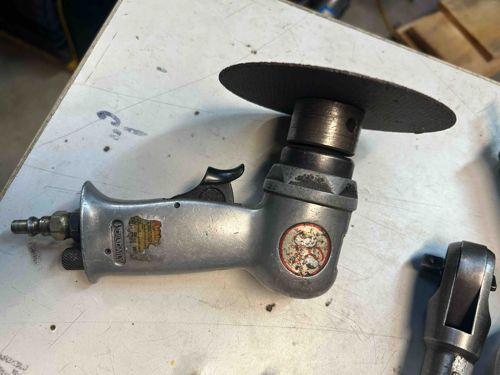
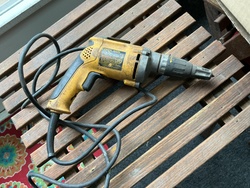
This item is an angle grinder, a type of power tool used for grinding, cutting, and polishing. It features a compact, handheld design with a metallic-grey cast aluminum or alloy body, indicating robust construction for industrial or heavy-duty use. The main body has a pistol-grip style handle that tapers towards the front. An air inlet fitting, likely a quick-connect pneumatic coupler, is visible at the rear of the handle, confirming it is an air-powered or pneumatic tool. A black trigger handle is present on the top of the grip for operation.
The cutting or grinding mechanism consists of a perpendicular head from which a dark, circular abrasive disc is mounted. The disc appears to be a thin cut-off wheel, suggesting its primary function is for cutting metal or similar materials. There are visible signs of wear and tear consistent with a used tool, including scuffs, scratches, and some discoloration on the metal body. There is a partially obscured rectangular label or sticker on the side of the handle, with some text possibly indicating 'SNAP-ON' or a similar brand, and another circular, reddish-orange emblem with white or light-colored markings that seem to be an older, faded logo. The overall condition suggests it is well-used but functionally intact, with a visible patina that speaks to its age and regular employment. The craftsmanship appears to be industrial standard, built for durability and performance in a professional setting. The general style and visible wear suggest an estimated age of mid-to-late 20th century.
AI Appraisal Report
Upon examining the provided image of this pneumatic angle grinder with a cut-off wheel, I've assessed its condition and potential value. The tool appears to be robustly constructed from cast aluminum or a similar alloy, consistent with industrial-grade equipment. The visible scuffs, scratches, and discoloration indicate significant use, but the overall patina suggests a well-maintained tool rather than one that has been abused. The partially obscured 'SNAP-ON' branding, if confirmed, is a significant positive factor, as Snap-On tools are renowned for their quality, durability, and strong resale value, even used. The reddish-orange emblem also hints at a vintage association, potentially from a time when Snap-On offered lifetime warranties or unique marketing.
Market conditions for vintage Snap-On pneumatic tools, while not in the same league as collectibles, show consistent demand from professional mechanics, hobbyists, and those who appreciate durable tools built to last. Compared to modern, often less robust, alternatives, an older Snap-On tool in functional condition holds its appeal. Rarity, in this case, is moderate; while not unique, this specific model from the mid-to-late 20th century is less common than contemporary variants.
Factors significantly impacting value include the potential Snap-On authenticity, its operational condition (which cannot be verified visually), and the tool's intended use. If fully functional, its utility adds intrinsic value.
It is crucial to note the limitations in authenticity verification from images alone. While the visible markings suggest Snap-On, a definitive confirmation would require an in-person examination to verify tool markings, serial numbers (if present), and material quality. Furthermore, to ascertain full functionality and internal wear, a physical inspection, ideally including operational testing, would be necessary. Provenance documentation, such as original purchase receipts or service records, would also provide stronger authentication and could further enhance its value.