AI estimate as of August 31, 2025 · verify with a professional before acting
AI-Generated · Verify before acting
Everything on this page is generated by AI for informational purposes only. AI can make mistakes — the AI may misidentify items or misattribute them (artist, maker, brand, designer, origin, era). This is not an official valuation and should not be used for insurance, sale, tax, estate, legal, or lending purposes — or any decision requiring a certified appraisal. It is not an authoritative claim about any person, brand, or rights holder — do not share or rely on it as a factual statement about a third party. Always consult qualified professionals before making financial decisions.
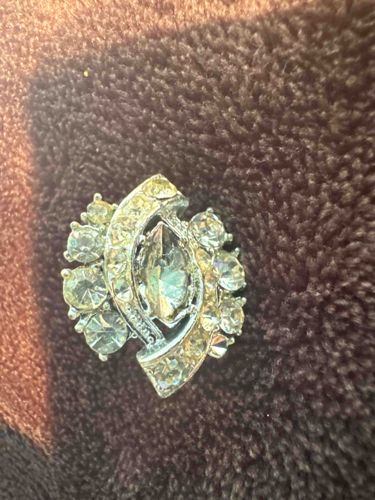
This is a vintage-style rhinestone brooch or dress clip, likely from the mid-20th century, possibly the 1940s to 1960s, indicated by its design and material choices. The piece features a central marquise-cut, clear rhinestone, which is the focal point. This central stone is flanked by two gracefully curving, intertwined bands of smaller, round-cut clear rhinestones, creating a distinctive swirling or ribbon-like motif around the center. On either side of this central arrangement, there are clusters of larger, round-cut clear rhinestones, with three visible on the left and four on the right, forming a somewhat asymmetrical yet balanced composition. The metal setting appears to be a silver-toned base metal, such as pot metal or rhodium-plated sterling silver, common for costume jewelry of the era. The rhinestones exhibit good clarity and sparkle, though some appear to have a slight yellowish tint, which could be due to age, adhesive discoloration, or the original quality of the stones. The metal shows some signs of wear, particularly along the edges and raised areas, suggesting possible loss of plating or tarnishing. There are no obvious missing stones, but the overall condition suggests it has been worn and enjoyed. The craftsmanship indicates a manufactured piece, consistent with mass-produced costume jewelry, yet it possesses a decorative elegance suitable for formal wear or accentuating garments.
AI Appraisal Report
Upon my virtual examination of this vintage rhinestone brooch/dress clip, I can discern several key characteristics. The design, with its central marquise-cut clear rhinestone flanked by intricate swirling bands of smaller round rhinestones and clusters of larger stones, strongly aligns with mid-20th century costume jewelry, likely dating from the 1940s-1960s. The clear rhinestones generally exhibit good sparkle; however, the slight yellowing visible in some suggests either age-related discoloration of the stones themselves or degradation of the adhesive used. The silver-toned metal setting, likely pot metal or plated base metal, shows some wear, consistent with an item that has been used and enjoyed over decades. There appear to be no missing stones, which is a positive for its condition.
In terms of market conditions, vintage costume jewelry, while popular, largely depends on condition, rarity of design, and material quality. This piece, while aesthetically pleasing, appears to be a manufactured item typical of mass-produced costume jewelry of its era. Its condition, while good for its age, is not pristine, and the potential discoloration of stones and wear to the plating preclude it from higher valuations. Demand for pieces like this remains steady among collectors of vintage costume jewelry, but it is not rare enough to command a premium. Factors impacting value include the non-precious metals and synthetic stones, common wear, and the general availability of similar items.
It is crucial to note the limitations of appraising from images alone. Without physical inspection, I cannot definitively determine the exact metal composition (e.g., distinguish between rhodium-plated sterling silver and a base metal like pot metal), accurately assess the extent of rhinestone discoloration or clarity, or verify the integrity of the settings. An in-person examination would allow for tactile assessment of the weight, closer inspection of stone quality under magnification, and assessment of the clasp mechanism. Provenance documentation, though unlikely for an item of this type, would confirm its history. Scientific testing, such as XRF analysis, would be necessary for definitive material identification.