AI estimate as of July 24, 2025 · verify with a professional before acting
AI-Generated · Verify before acting
Everything on this page is generated by AI for informational purposes only. AI can make mistakes — the AI may misidentify items or misattribute them (artist, maker, brand, designer, origin, era). This is not an official valuation and should not be used for insurance, sale, tax, estate, legal, or lending purposes — or any decision requiring a certified appraisal. It is not an authoritative claim about any person, brand, or rights holder — do not share or rely on it as a factual statement about a third party. Always consult qualified professionals before making financial decisions.
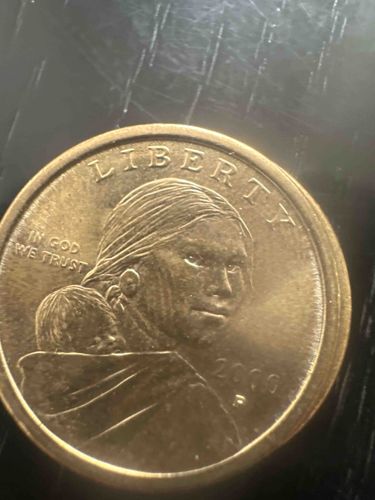
The item is a United States Sacagawea Golden Dollar coin, specifically from the year 2000, as visible by the prominent '2000' mint date on the obverse. This coin is known for its distinctive golden color, which is a result of its manganese brass clad composition (88.5% copper, 6% zinc, 3.5% manganese, 2% nickel) over a pure copper core. The obverse features Glenna Goodacre's design of Sacagawea, a Shoshone woman, looking forward, with her infant son Jean Baptiste Charbonneau (
AI Appraisal Report
Upon visual examination of the provided image, I can confirm this is indeed a United States Sacagawea Golden Dollar coin, dated 2000. The prominent '2000' mint date on the obverse is clear, and the overall golden hue is consistent with its manganese brass clad composition. The design elements, including Sacagawea and her infant son, appear standard for this issue.
Regarding condition, from the image, the coin appears to be in circulated condition. I observe what seem to be minor surface abrasions and possibly some luster breaks, typical of a coin that has been in general circulation. Without higher resolution images or physical inspection, it is difficult to assign a precise Sheldon grading, but it does not appear to be an uncirculated specimen.
Authenticity, based solely on this image, cannot be definitively proven. The design and date align with genuine Sacagawea dollars. However, without in-hand examination, I cannot rule out the possibility of a counterfeit, although fakes of common circulating issues like this are less prevalent than for rare coins. A physical inspection would allow me to assess the coin's weight, diameter, edge reeding, and metallic sound, which are crucial for full authentication. Provenance documentation, though less common for individual circulating coins, would also strengthen authenticity claims.
Market conditions for 2000 Sacagawea dollars are generally stable. This coin, being from the first year of issue, holds a slight appeal to collectors, but millions were minted, making it very common. Comparables in similar circulated condition typically trade close to face value. Demand for a circulated 2000 Sacagawea dollar is low among serious collectors, as premium examples (uncirculated, proofs, or error coins) are readily available. Its rarity is negligible. Factors impacting value negatively are its commonality and apparent circulated condition. If this were an uncirculated example or a known error variety (like the Cheerio or Wounded Eagle varieties), the value would be significantly higher. Without clear evidence of such rare attributes, its value remains at the lower end of the spectrum.
Limitations: My assessment of condition is based solely on the provided image, which may not capture all nuances of wear, scratches, or luster. Full authentication requires physical examination, including weight and dimension verification, edge inspection, and potentially specialized metallurgic testing for absolute certainty regarding composition, although this is usually not necessary for common circulating issues.