These notes were written by the person who submitted this item. Appraiser.AI has not verified them, and the AI's identification and estimate may rely on them.
AI Estimated Value
Not an official valuation
$2,500-$4,000
AI estimate as of September 9, 2025 · verify with a professional before acting
AI-Generated · Verify before acting
Everything on this page is generated by AI for informational purposes only. AI can make mistakes — the AI may misidentify items or misattribute them (artist, maker, brand, designer, origin, era). This is not an official valuation and should not be used for insurance, sale, tax, estate, legal, or lending purposes — or any decision requiring a certified appraisal. It is not an authoritative claim about any person, brand, or rights holder — do not share or rely on it as a factual statement about a third party. Always consult qualified professionals before making financial decisions.
This analysis also relies on unverified notes provided by the user, which may be incomplete or inaccurate and could affect the result.
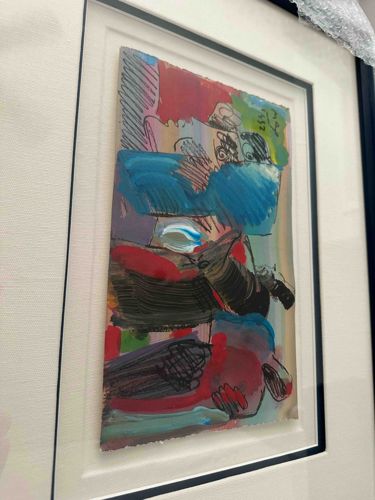
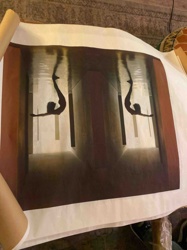
This item is a framed mixed media artwork by Peter Max, dating from 1992 based on the visible signature and date. The artwork is characterized by an abstract composition, primarily featuring broad, expressive brushstrokes and areas of vibrant color, overlaid with energetic calligraphic black line work. The dominant colors include various shades of red, blue, black, green, and purple, applied in a somewhat gestural manner, creating distinct blocks and overlapping forms. The black lines appear to be charcoal, pastel, or oil stick, adding texture and defining abstract shapes and perhaps rudimentary facial features or figures within the broader color fields. The medium appears to be a combination of acrylic or gouache paints and possibly crayon, oil pastel, or charcoal on paper. The paper itself has deckled or slightly uneven edges, suggesting it is a heavy art paper or torn from a larger sheet. The overall condition of the artwork appears good, with no obvious tears or significant disfigurement visible, maintaining its original vibrant colors. The artwork is presented within a white mat and a black frame, indicating it has been protected and displayed. The craftsmanship is typical of Peter Max's style, known for its bold colors and pop art influences, showcasing a confident and fluid application of media. The visible signature 'Max' and '1992' in the upper right quadrant are distinguishing features that confirm both the artist and the year of creation.
AI Appraisal Report
Based on my visual examination of the provided image, this 1992 Peter Max mixed media artwork, 'Abstract Composition,' appears to be in very good condition. The colors retain their vibrancy, and there are no visible tears, significant abrasions, or foxing that would detract from its overall appeal. The white mat and black frame suggest it has been adequately protected.
From the image, the 'Max 1992' signature in the upper right quadrant appears consistent with known examples of Peter Max's autograph from that period, lending strong initial support to its authenticity. The bold colors, abstract yet gestural application, and characteristic calligraphic lines are all hallmarks of Max's distinctive style, particularly from the early 1990s when his work remained highly sought after. The combination of paint (likely acrylic or gouache) and expressive lines (charcoal, pastel, or oil stick) on what appears to be heavy art paper with deckled edges is also typical of his mixed media compositions.
The market for Peter Max's work remains strong, especially for original mixed media pieces from his more prolific periods. Works from the early 1990s are generally well-regarded within his oeuvre. Comparable sales for similar-sized mixed media abstracts by Max from this era typically fall within the $2,500 to $4,000 range, depending on the specific composition's appeal and historical significance. The abstract nature, while perhaps not as iconic as some of his pop art figures, offers broad decorative appeal.
However, it is crucial to state the limitations of an appraisal based on images alone. While the visible characteristics are highly indicative of authenticity, a definitive authentication would require a direct, in-person examination. This would allow for a tactile inspection of the media, paper quality, and the signature's execution, as well as an assessment for any potential signs of alteration or reproduction. Furthermore, robust provenance documentation, such as a certificate of authenticity from the artist’s studio, a reputable gallery, or a comprehensive sales history, would significantly enhance its market value and assure absolute authenticity. Without these, while the visual evidence is compelling, a degree of uncertainty remains, which is factored into the value range.