These notes were written by the person who submitted this item. Appraiser.AI has not verified them, and the AI's identification and estimate may rely on them.
AI Estimated Value
Not an official valuation
$75-125
AI estimate as of July 2, 2025 · verify with a professional before acting
AI-Generated · Verify before acting
Everything on this page is generated by AI for informational purposes only. AI can make mistakes — the AI may misidentify items or misattribute them (artist, maker, brand, designer, origin, era). This is not an official valuation and should not be used for insurance, sale, tax, estate, legal, or lending purposes — or any decision requiring a certified appraisal. It is not an authoritative claim about any person, brand, or rights holder — do not share or rely on it as a factual statement about a third party. Always consult qualified professionals before making financial decisions.
This analysis also relies on unverified notes provided by the user, which may be incomplete or inaccurate and could affect the result.
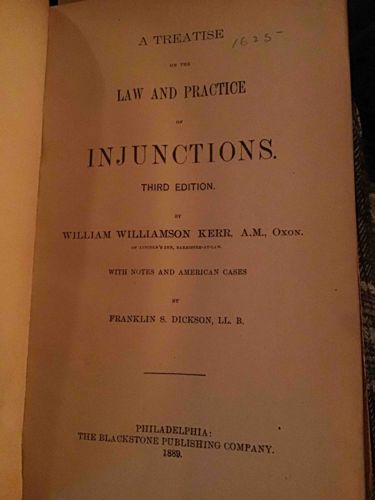
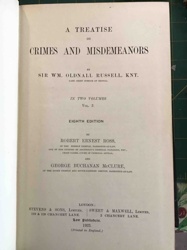
This item is a vintage legal treatise titled 'A Treatise on the Law and Practice of Injunctions,' specifically the Third Edition. The physical characteristics indicate it is a bound book, likely with a hardcover, although only the title page is fully visible. The paper appears aged, exhibiting a warm beige or off-white hue, consistent with its manufacture in the late 19th century. The text is printed in black ink, featuring a clear, legible serif typeface. The layout is classical, with prominent title headings and author information centrally aligned. Notable elements include the authorship attributed to William Williamson Kerr, A.M., Oxon., with additional notes and American cases by Franklin S. Dickson, LL.B. The publishing details are clearly stated: published by The Blackstone Publishing Company in Philadelphia in 1889. There is a handwritten notation '1625-' in what appears to be pencil or faded ink at the top right of the title page, which may be an old price, inventory number, or reference mark. The overall visible condition is good, showing appropriate aging for its age without major rips, tears, or significant staining on the visible page. The page edges appear relatively clean, and the printing remains sharp. The craftsmanship suggests a standard production for a legal publication of its era, with good quality paper and printing. Its age places it firmly in the late Victorian period.
AI Appraisal Report
Based on my visual examination of the provided image and the owner's description of "Good condition," I assess this 1889 Third Edition of 'A Treatise on the Law and Practice of Injunctions' to be in commendable shape for its age. The visible title page exhibits appropriate aging, including a warm, consistent patina on the paper, without apparent foxing, significant staining, or tears. The print remains sharp and legible, indicating good paper quality and original production standards. The handwritten notation '1625-' is intriguing; it could be an old inventory number or a price from a previous sale, but its exact meaning is speculative without further context.
In terms of market conditions, vintage legal treatises like this have a niche but consistent demand among legal historians, collectors of antique law books, and those seeking early editions of influential works. Comparables typically range, with factors like the author's prominence, the subject matter's historical significance, and especially the book's physical condition dictating value. William Williamson Kerr was a respected legal scholar, and injunctions remain a foundational area of law.
This specific edition's rarity is moderate; while not exceedingly rare, a well-preserved copy from this period is not commonplace. Demand is primarily from academic institutions or private collectors with a specific interest in legal history. Factors enhancing value include its completeness (assuming all pages are present), the solid binding (which cannot be fully assessed from the image), and the overall preservation of the text block. The reported 'Good condition' from the owner is a significant positive factor.
Limitations in authenticity verification from images alone are notable. I cannot definitively assess the integrity of the binding, confirm the absence of internal damage (such as missing pages, extensive marginalia, or significant water damage not visible on the title page), or verify the paper's brittleness. A physical examination would allow me to inspect the spine, endpapers, and page block for structural integrity, confirm the absence of repairs or significant restoration, and assess the overall tactile quality. Provenance documentation, such as records of previous ownership, would add to its historical value and aid in authentication beyond what visual inspection can provide.