AI estimate as of July 10, 2025 · verify with a professional before acting
AI-Generated · Verify before acting
Everything on this page is generated by AI for informational purposes only. AI can make mistakes — the AI may misidentify items or misattribute them (artist, maker, brand, designer, origin, era). This is not an official valuation and should not be used for insurance, sale, tax, estate, legal, or lending purposes — or any decision requiring a certified appraisal. It is not an authoritative claim about any person, brand, or rights holder — do not share or rely on it as a factual statement about a third party. Always consult qualified professionals before making financial decisions.
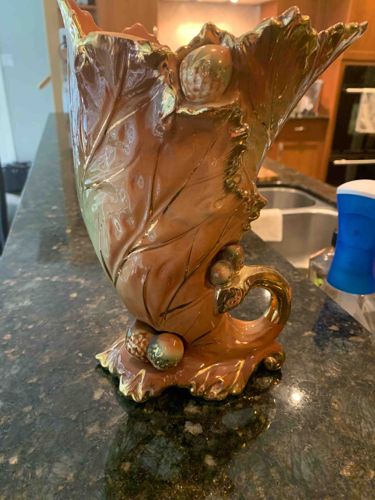
This item is a decorative ceramic vase or planter, likely designed for holding flowers or a small plant. Its design prominently features autumnal and nature-inspired motifs, primarily large oak leaves and acorns, rendered in a three-dimensional, relief style. The dominant color is a warm, earthy brown or russet, with accents of gold or gilded details highlighting the edges of the leaves, the caps of the acorns, and other raised elements. Some areas, particularly on the acorns and subtle hints on the leaves, show touches of green, suggesting a naturalistic approach to coloration. The surface has a glossy, glazed finish, reflecting light and indicating it's made from pottery or earthenware. The construction appears to be molded, with distinct veining visible on the leaf surfaces, enhancing their organic appearance. There is a handle-like element integrated into the lowest leaf on the right side, which also incorporates an acorn. The base is irregular, formed by overlapping leaves and acorns, providing stability to the piece. The overall condition appears good from the visible angles, with no obvious major cracks or chips, though minor wear to the gilded accents or small glaze imperfections might be present upon closer inspection. The style suggests a late 19th to mid-20th-century aesthetic, possibly Art Nouveau or early Art Deco, given the organic forms and decorative emphasis. The craftsmanship seems of moderate to good quality, with attention paid to the sculptural details of the natural elements.
AI Appraisal Report
Upon visual examination of the provided images, this autumnal-themed ceramic vase presents as a finely crafted decorative piece, likely of American or European origin, dating from the late 19th to early 20th century. The style evokes Arts and Crafts or late Art Nouveau sensibilities, with its naturalistic oak leaf and acorn motifs rendered in high relief. The rich, earthy brown glaze accented with gilded highlights on the leaf edges and acorn caps is characteristic of this era. The condition appears to be very good, with the glaze intact and no visible chips, cracks, or significant crazing from the photographs. However, the value is contingent on this apparent condition Holding up under physical inspection, as minor hairline cracks or restoration can significantly decrease value. The market for this type of decorative earthenware is stable. Comparable pieces from makers like Weller, Roseville, or European potteries of the period, with similar size and decorative complexity, typically sell in the $75 to $200 range at auction, depending on maker identification and condition. The demand is moderate, appealing to collectors of seasonal decor and Arts and Crafts pottery. A key factor influencing its value is the maker's mark, which cannot be determined from the images. A confirmed attribution to a desirable maker could increase the value substantially. Full authentication would require in-person examination to inspect for a maker's mark on the underside, analyze the clay body and glaze composition, and use UV light to detect any professional repairs or restoration not visible to the naked eye.