AI estimate as of December 4, 2025 · verify with a professional before acting
AI-Generated · Verify before acting
Everything on this page is generated by AI for informational purposes only. AI can make mistakes — the AI may misidentify items or misattribute them (artist, maker, brand, designer, origin, era). This is not an official valuation and should not be used for insurance, sale, tax, estate, legal, or lending purposes — or any decision requiring a certified appraisal. It is not an authoritative claim about any person, brand, or rights holder — do not share or rely on it as a factual statement about a third party. Always consult qualified professionals before making financial decisions.
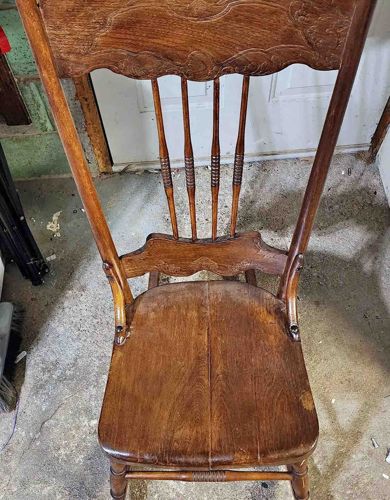
This appears to be an antique rocking chair, crafted primarily from oak wood, exhibiting a rich, dark brown finish that highlights the natural grain. The chair features a distinctive contoured and carved crest rail at the top of the backrest, displaying ornate scrollwork or floral motifs that are detailed but appear somewhat softened by wear. Below the crest rail, there are four turned spindles forming the upper back, each featuring a reeded or ring-turned section for added decorative interest. The seat of the chair is a solid, shaped wooden plank, with visible wood grain and some areas showing wear, particularly along the front edge and where the seat meets the back. The arms of the rocking chair are of a steam-bent or curved design, extending upwards from the front of the seat and flowing into the back stiles. There are visible fasteners, likely screws or bolts, where the arms attach to the back stiles, which may indicate a repair or original construction method. The legs appear turned, and there are visible stretchers between them for stability, though the full extent of the base is not entirely visible. The overall condition suggests significant age and use, with a well-worn patina, scuffs, scratches, and possible chipping or loss of finish in areas. The construction appears to be solid, indicative of traditional woodworking techniques. This chair likely dates from the late 19th to early 20th century, consistent with Victorian or Arts and Crafts era designs, given the carving and turned elements.
AI Appraisal Report
Based on my visual examination of the provided image, this Antique Carved Oak Rocking Chair appears to be a genuine piece dating from the late 19th to early 20th century, likely from the Victorian or early Arts and Crafts period. The dark-stained oak, contoured carved crest rail with ornate scrollwork (though softened by wear), turned spindles with reeded sections, and solid shaped wooden seat are consistent with styles from these eras. The steam-bent or curved arms flowing into the back stiles also align with period construction. The visible fasteners where the arms attach to the back stiles could be original construction, but without closer inspection, I cannot rule out a significant repair. The overall condition suggests considerable age and use, exhibiting a well-worn patina, scuffs, scratches, and areas of finish loss, particularly on the seat and edges. This wear is expected for a functional piece of this age and contributes to its authentic period feel rather than detracting significantly, assuming structural integrity.
From a market perspective, antique rocking chairs of this type, while charming, generally fall into a moderate value range. There is a steady, but not exceptionally high, demand for sturdy, attractive oak pieces from this period. Comparables in the current market often feature similar designs and condition, typically selling for a few hundred dollars. Rarity is not a significant factor here; while each piece is unique, this style of oak rocking chair was produced in high numbers. Factors impacting value are primarily the condition (which is consistent with age but not pristine), the attractive carving, and the solid construction, which appears able to withstand further use. The visible wear actually enhances its antique aesthetic. Limitations in authentication from the image alone include verifying wood species definitively, checking for internal repairs not visible externally, and confirming the originality of all components. A hands-on inspection would allow me to assess the soundness of all joints, the stability of the rocking mechanism, and the extent and nature of any repairs or alterations. Provenance documentation would, of course, add to its historical value and confirm its specific journey.