AI estimate as of July 29, 2025 · verify with a professional before acting
AI-Generated · Verify before acting
Everything on this page is generated by AI for informational purposes only. AI can make mistakes — the AI may misidentify items or misattribute them (artist, maker, brand, designer, origin, era). This is not an official valuation and should not be used for insurance, sale, tax, estate, legal, or lending purposes — or any decision requiring a certified appraisal. It is not an authoritative claim about any person, brand, or rights holder — do not share or rely on it as a factual statement about a third party. Always consult qualified professionals before making financial decisions.
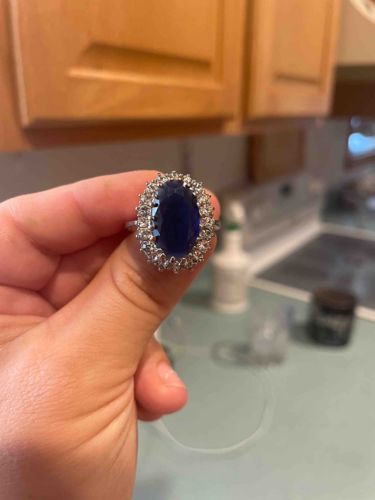
The item is an oval-cut sapphire and diamond cluster ring. The central stone is a prominent, large, oval-cut sapphire with a deep, rich blue hue, possibly indicating a natural sapphire, though without further testing, it could be a synthetic or treated stone. Its facets are clearly visible, reflecting light and creating depth of color. Surrounding the central sapphire is a halo of numerous smaller, round brilliant-cut diamonds or diamond simulants. These stones are set closely together, creating a sparkling frame that enhances the size and brilliance of the central gem. The setting appears to be white metal, likely silver, white gold, or platinum, given its bright, reflective finish. The overall design is classic and elegant, reminiscent of engagement or cocktail rings from the mid-to-late 20th century or contemporary reproductions inspired by that era. There are no visible signs of significant damage like chips or cracks on the stones, and the metal shows a good polish with no obvious tarnish. The craftsmanship appears to be of decent quality, with the stones well-seated within their prongs or bezel settings. The back of the ring and shank are not clearly visible, preventing assessment of any maker's marks or further structural details. Its prominent size suggests it is designed to be a statement piece.
AI Appraisal Report
Upon my visual examination of this Oval Sapphire and Diamond Cluster Ring, I observe a classic and elegant design. The central stone is a prominent oval-cut sapphire displaying a rich blue hue, which is highly desirable. Surrounding it is a halo of what appear to be numerous round brilliant-cut diamonds, set closely to enhance the central stone's brilliance. The setting is bright white metal, likely white gold or platinum, contributing to its refined appearance.
From the image, the condition appears excellent; there are no visible chips or cracks on the stones, and the metal shows good polish without tarnish. The craftsmanship seems decent, with stones well-seated. However, it's crucial to state that authenticity and precise quality cannot be definitively determined from images alone. The sapphire's origin (natural vs. synthetic), treatment status, and overall clarity/cut grade are unconfirmable. Similarly, the diamond quality (color, clarity, cut, carat weight) and whether they are natural diamonds or simulants cannot be verified without in-person inspection and scientific testing (e.g., refractometer, spectroscopy, diamond tester). The metal's purity also requires physical testing or hallmark examination.
Market conditions for classic sapphire and diamond cluster rings remain strong, driven by timeless appeal and their suitability as both engagement and cocktail rings. Comparables would vary widely based on stone quality and metal type. Demand for such pieces is consistent, particularly for well-executed designs. The primary factors impacting value here are the actual quality and authenticity of the sapphire and diamonds, and the metal's purity. Without these verifiable details, any value is an estimation.
To provide a full and accurate appraisal, I would require a physical examination to assess the sapphire for treatments, origin, and specific quality characteristics; test the diamonds for authenticity and grade them; and confirm the metal through hallmarks or testing. Provenance documentation, if available, would also be invaluable.