These notes were written by the person who submitted this item. Appraiser.AI has not verified them, and the AI's identification and estimate may rely on them.
AI Estimated Value
Not an official valuation
$50 - $100
AI estimate as of July 19, 2025 · verify with a professional before acting
AI-Generated · Verify before acting
Everything on this page is generated by AI for informational purposes only. AI can make mistakes — the AI may misidentify items or misattribute them (artist, maker, brand, designer, origin, era). This is not an official valuation and should not be used for insurance, sale, tax, estate, legal, or lending purposes — or any decision requiring a certified appraisal. It is not an authoritative claim about any person, brand, or rights holder — do not share or rely on it as a factual statement about a third party. Always consult qualified professionals before making financial decisions.
This analysis also relies on unverified notes provided by the user, which may be incomplete or inaccurate and could affect the result.
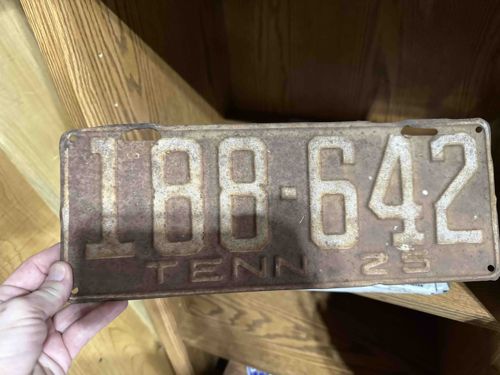
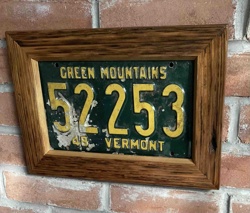
The item is an antique Tennessee license plate, likely from the year 1925, as indicated by the '25' embossed on the bottom right. The plate measures approximately 14-16 inches in length and 6-7 inches in height, consistent with standard early 20th-century license plate dimensions. It is constructed from metal, likely steel, given the heavy oxidation. The original color scheme appears to have been white or light-colored embossed numbers and letters on a dark, possibly black or dark brown, background. However, due to significant rust and patina, the surface now exhibits various shades of reddish-brown and gray. The embossed characters '188-642' are prominently displayed in the center, with 'TENN' embossed below the first set of numbers on the left and '25' below the second set on the right. There are four mounting holes, one in each corner, which are visible and appear to be intact, though the metal around them shows signs of wear and slight deformation. The overall condition is heavily distressed, indicating prolonged exposure to elements. There is extensive surface rust covering the entire plate, with some pitting, particularly in the lower sections and along the edges. The corners are rounded, and the edges show some minor bends and irregularities, consistent with age and use. Despite the heavy patina, the embossed details remain legible, showcasing the craftsmanship of early license plate manufacturing. The quality is indicative of mass-produced items from that period, designed for durability rather than aesthetic longevity.
AI Appraisal Report
I have examined the provided images and details for this 1925 Tennessee license plate. Authenticity appears strong based on the 'TENN' and '25' embossing, consistent with known plates from this era. The dimensions provided align with typical early 20th-century automotive plates. The heavily distressed condition, characterized by extensive surface rust, pitting, and patina, is indicative of genuine age and prolonged outdoor exposure. While the original colors are obscured, the legibility of the embossed numbers ('188-642') and state/year identifiers is crucial for value.
From a market perspective, single antique license plates, particularly those in heavily weathered condition, typically command modest values. Demand exists among automobilia collectors, Tennessee history enthusiasts, and those seeking decorative garage items. Rarity for common states like Tennessee from the mid-1920s is moderate; these plates surface regularly. Factors significantly impacting value here are the legibility and the fact it's a complete, albeit rusty, example. The lack of vibrant original color and heavy degradation are detractions.
My assessment for condition relies solely on the provided images. For full authentication, an in-person examination would be critical to confirm material composition (e.g., steel type), depth of pitting, and to rule out modern reproductions attempting to mimic age. Physical inspection could also reveal subtle details not clear in photos. Provenance documentation, such as the vehicle it adorned or how it was acquired, would add considerable value and certainty, but is rarely available for such items. Scientific testing, like XRF analysis for paint remnants or metal composition, could definitively verify age and originality, but is usually reserved for higher-value items.