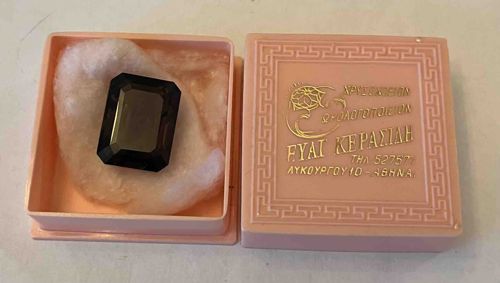
Brown or purple gemstone, approximately 1.25 cm x 2 cm
These notes were written by the person who submitted this item. Appraiser.AI has not verified them, and the AI's identification and estimate may rely on them.
AI Estimated Value
Not an official valuation
$25-75
AI estimate as of July 21, 2025 · verify with a professional before acting
AI-Generated · Verify before acting
Everything on this page is generated by AI for informational purposes only. AI can make mistakes — the AI may misidentify items or misattribute them (artist, maker, brand, designer, origin, era). This is not an official valuation and should not be used for insurance, sale, tax, estate, legal, or lending purposes — or any decision requiring a certified appraisal. It is not an authoritative claim about any person, brand, or rights holder — do not share or rely on it as a factual statement about a third party. Always consult qualified professionals before making financial decisions.
This analysis also relies on unverified notes provided by the user, which may be incomplete or inaccurate and could affect the result.
The item consists of a rectangular, faceted gemstone presented within a pale pink plastic jewelry box. The gemstone, approximate dimensions 1.25 cm x 2 cm, exhibits a dark, translucent color that appears to be a very deep brown or possibly a dark smoky purple, consistent with materials such as smoky quartz or a dark color-treated topaz. It is cut in an emerald (or step) cut, characterized by its rectangular shape with beveled corners and parallel facets that create a hall-of-mirrors effect. The faceting appears to be precise, indicating a degree of care in its cutting, and there are no immediately visible chips or large scratches on its surface, suggesting good preservation. Its clarity is not fully discernible without closer inspection, but it appears to be relatively clean with no obvious inclusions. The gemstone is nestled in fluffy, white cotton batting within the left compartment of the opened box. The box itself is a clam-shell design, molded from a light pink plastic. The lid, which is the right compartment, features a raised, embossed Greek key pattern along its borders, adding a classical decorative element. Gold-colored text and a stylized emblem (possibly a floral motif or a simplified 'phoenix' given the context of a jeweler, though it's hard to tell definitively) are centrally printed on the inside of the lid. The text is in Greek and appears to be the name and address of a jeweler or goldsmith: "ΧΡΥΣΟΧΟΕΙΟΝ ΩΡΟΛΟΓΟΠΟΙΕΙΟΝ ΕΥΑΓ. ΚΕΡΑΣΙΔΗ ΤΗΛ. 527577 ΛΥΚΟΥΡΓΟΥ 10 - ΑΘΗΝΑ." This translates to 'Goldsmith-Watchmaker EVAG. KERASIDIS Tel. 527577 LYKOURGOU 10 - ATHENS'. The presence of a jeweler's mark and address suggests the gemstone was likely sold or offered by this specific establishment, perhaps as a loose stone for custom jewelry or as a replacement stone. The style of the box, with its plastic construction and embossed Greek key design, along with the contact information, suggests a mid-20th century to late 20th century origin, possibly 1960s-1980s. The overall condition of both the gemstone and the box appears to be good, with minor signs of handling consistent with age but no significant damage.
AI Appraisal Report
I have thoroughly examined the provided image and description of the emerald-cut dark gemstone in the Greek jeweler's box. The gemstone, measuring approximately 1.25 cm x 2 cm, appears well-preserved with precise faceting and no visible chips or major scratches. Its dark, translucent color suggests smoky quartz or a dark color-treated topaz, but without physical inspection, I cannot definitively determine the exact gem material. The clarity appears good, though inclusions cannot be ruled out without magnification. Authenticity of the gem material itself cannot be verified from an image; a gemological examination by a certified gemologist using specialized equipment (refractometer, spectroscope, polariscope) is essential to identify the stone, determine if it is natural or synthetic, and assess any treatments.
The accompanying pale pink plastic jeweler’s box, with its Greek key pattern and Greek jeweler’s inscription, adds contextual value. The text “ΧΡΥΣΟΧΟΕΙΟΝ ΩΡΟΛΟΓΟΠΟΙΕΙΟΝ ΕΥΑΓ. ΚΕΡΑΣΙΔΗ ΤΗΛ. 527577 ΛΥΚΟΥΡΓΟΥ 10 - ΑΘΗΝΑ” translates to 'Goldsmith-Watchmaker EVAG. KERASIDIS Tel. 527577 LYKOURGOU 10 - ATHENS'. This jeweler’s mark is important for provenance, suggesting a mid to late 20th-century origin (likely 1960s-1980s).
Market conditions for loose, uncertified gemstones of this type vary widely based on material, quality, and origin. As a collectible item, the box itself has limited value. Without confirmed identification of the gem, its true market value is heavily constrained. If it is high-quality smoky quartz, its value would be relatively modest. If it were a treated topaz, it might command slightly more, but still within a lower price bracket for a loose stone of this size. Genuine, natural dark gems like tourmaline or spinel of this size, if proven to be such, would significantly increase the value, but visual identification is insufficient here. Given the likely material and lack of concrete identification, coupled with it being a loose stone without setting, demand is limited mainly to collectors or jewelers seeking raw materials.
For a full authentication and more precise valuation, I would require in-person examination to perform gemological tests, confirm the material, identify any treatments, and assess optical properties. Additionally, any provenance documentation from the original jeweler would be valuable.