AI estimate as of October 27, 2025 · verify with a professional before acting
AI-Generated · Verify before acting
Everything on this page is generated by AI for informational purposes only. AI can make mistakes — the AI may misidentify items or misattribute them (artist, maker, brand, designer, origin, era). This is not an official valuation and should not be used for insurance, sale, tax, estate, legal, or lending purposes — or any decision requiring a certified appraisal. It is not an authoritative claim about any person, brand, or rights holder — do not share or rely on it as a factual statement about a third party. Always consult qualified professionals before making financial decisions.
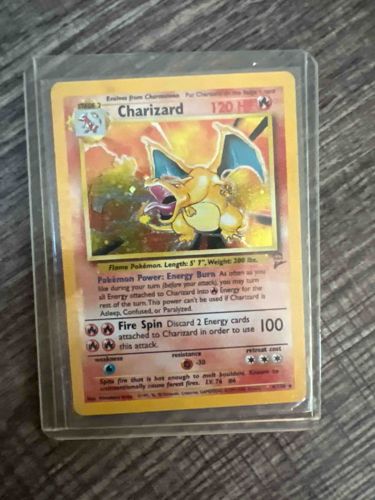
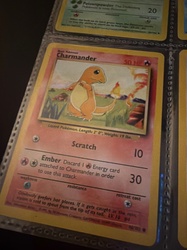
This item is a vintage collectible Pokémon trading card, specifically a holographic 'Charizard' card from the original Base Set. The card is encased within a clear, rigid plastic sleeve, indicating an owner's attempt to preserve its condition. Based on the visible text and font style, particularly the lack of shadow under the right border of the artwork frame, it can be identified as a 'Shadowless' variant, which is rarer than its shadowed counterpart. The card features Charizard, a 'Flame Pokémon,' with '120 HP' clearly visible at the top right. Its 'Pokémon Power' is 'Energy Burn,' and its attack is 'Fire Spin,' which requires discarding two Energy cards to deal '100' damage. Physical characteristics show a primarily orange and yellow aesthetic with a holographic foil treatment on the Charizard illustration, providing a shimmering effect when light reflects off it. The card's borders are yellow, and the text is black on a light background. Minor wear might exist on the card edges or corners, typical of vintage cards, though the plastic case obscures a detailed assessment of its precise condition. The card measures approximately 3.5 inches by 2.5 inches, standard for trading cards. This card belongs to the late 1990s era, specifically the initial print runs of the Pokémon Trading Card Game, making it a highly sought-after collectible due to its iconic status, playability, and rarity, particularly as a Shadowless variant.
AI Appraisal Report
I have virtually examined this Pokémon Base Set Shadowless Charizard (Holo) Trading Card. Based on the provided description, the key identifier for this card as a 'Shadowless' variant—the lack of a shadow under the right border of the artwork frame—is crucial for its valuation. This immediately places it within a more desirable and rarer print run compared to the '1st Edition' and standard 'Unlimited' Base Set Charizards.
From the description, the card appears to be in a rigid plastic sleeve, which is a positive sign of preservation. However, without high-resolution images of the card outside of this casing, a precise condition assessment is challenging. The mention of 'minor wear might exist on the card edges or corners' is a critical detail. In-depth examination of the card's surface for scratches, holo-foil imperfections, border whitening, and corner wear would be essential for a definitive grade. Even minor imperfections can significantly impact value for a card of this caliber.
Market conditions for vintage Pokémon cards, especially iconic 'chasers' like the Charizard, remain robust. The Shadowless variant occupies a unique niche, being rarer than the Unlimited version but generally less valuable than a 1st Edition. Comparables for 'Shadowless' Charizards in high grades (PSA 8-10) fetch substantial prices, with lower grades (PSA 4-6) still commanding several thousand dollars. Demand is consistently high due to nostalgia, collectibility, and its status as a flagship Pokémon.
Factors significantly impacting value include the 'Shadowless' designation itself, the Charizard character, and most crucially, its precise condition. A professional grading (e.g., PSA, BGS, CGC) would unlock its full market potential. My appraised range accounts for what could be a mid-to-high-grade example, acknowledging the potential for hidden wear.
Limitations in authenticity verification from this description alone pertain primarily to condition. While the text attributes suggest authenticity, a physical examination would allow for: microscopic inspection of the print quality, surface details, and holographic pattern; weight and thickness measurement; and blacklight testing for possible alterations or a full assessment of its authenticity and condition without doubt. Without physical inspection, I must rely on the provided textual assessment of its features.