AI estimate as of September 19, 2025 · verify with a professional before acting
AI-Generated · Verify before acting
Everything on this page is generated by AI for informational purposes only. AI can make mistakes — the AI may misidentify items or misattribute them (artist, maker, brand, designer, origin, era). This is not an official valuation and should not be used for insurance, sale, tax, estate, legal, or lending purposes — or any decision requiring a certified appraisal. It is not an authoritative claim about any person, brand, or rights holder — do not share or rely on it as a factual statement about a third party. Always consult qualified professionals before making financial decisions.
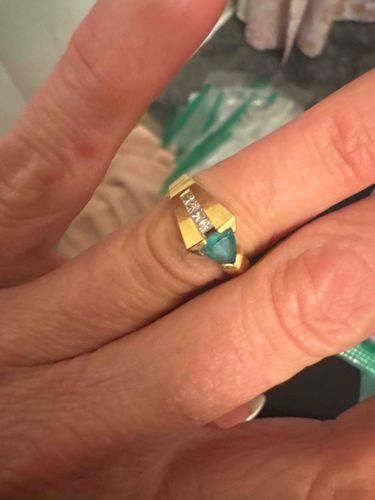
This item is a ring, likely crafted from yellow gold given its warm, rich metallic color. The design appears to draw inspiration from the Art Deco period, characterized by its geometric lines and stepped or angular elements. The ring's head features a prominent, bezel-set, pear-shaped or teardrop-shaped gemstone in a vivid teal or blue-green hue, suggesting it could be a tourmaline, Paraiba tourmaline, or a similar gemstone. Flanking this central stone are two stepped shoulders, each adorned with a channel-set row of small, round, brilliant-cut diamonds. There appear to be at least three diamonds on each side, bringing the total visible diamond count to six. The gold setting for the diamonds also exhibits angular, architectural elements that are consistent with Art Deco aesthetics. The overall construction suggests a solid, well-made piece, with the gold appearing polished and in good condition, showing no significant signs of tarnishing or heavy wear visible in the image. There are no obvious chips, cracks, or loose settings apparent for either the central gemstone or the diamonds. The craftsmanship seems of a good quality, with precise setting of the stones and clean lines in the metalwork. Without clearer images of the inside of the band, no specific maker's marks, signatures, or stamps can be identified. Based on its style, the ring likely dates from the mid-20th century or is a modern reproduction or tribute to the Art Deco era.
AI Appraisal Report
Based on my visual examination of the provided image, this Art Deco Style Gold Ring with a teal gemstone and diamond accents presents as a well-crafted piece. The warm metallic color suggests yellow gold, and its polished condition shows no significant tarnish or heavy wear. The central pear-shaped, vivid teal gemstone is bezel-set and appears to be in excellent condition, with no visible chips or cracks. The flanking shoulders, each with a channel-set row of approximately three round brilliant-cut diamonds, totaling around six visible diamonds, also appear securely set without any loose stones. The geometric lines and angular elements are characteristic of Art Deco design, suggesting it is either a period piece from the mid-20th century or a high-quality modern reproduction paying homage to the era. The craftsmanship, with its precise stone settings and clean metalwork, points to good quality. Authenticity of the gemstones (specifically identifying the teal stone as tourmaline, Paraiba tourmaline, or another gem, and confirming diamond authenticity) cannot be definitively determined from imagery alone. Similarly, gold purity and maker's marks require in-person inspection. Market demand for Art Deco style jewelry remains consistently strong, especially for pieces with vibrant central gemstones and diamond accents. The rarity of genuine period pieces can drive up value, while well-made reproductions also hold significant appeal. The primary factors impacting value here are the actual gemstone identification and quality, the carat weight and clarity of the diamonds, and the gold purity. Without physical examination, including gemological testing for the teal stone and diamonds, and identification of any hallmarks, this appraisal relies solely on visible characteristics and market trends for similar-looking items. A full authentication would necessitate in-person examination, specific gravity tests for the gemstone, diamond testing, and an assessment of metal purity.