These notes were written by the person who submitted this item. Appraiser.AI has not verified them, and the AI's identification and estimate may rely on them.
AI Estimated Value
Not an official valuation
$1,200 - $1,800
AI estimate as of June 28, 2025 · verify with a professional before acting
AI-Generated · Verify before acting
Everything on this page is generated by AI for informational purposes only. AI can make mistakes — the AI may misidentify items or misattribute them (artist, maker, brand, designer, origin, era). This is not an official valuation and should not be used for insurance, sale, tax, estate, legal, or lending purposes — or any decision requiring a certified appraisal. It is not an authoritative claim about any person, brand, or rights holder — do not share or rely on it as a factual statement about a third party. Always consult qualified professionals before making financial decisions.
This analysis also relies on unverified notes provided by the user, which may be incomplete or inaccurate and could affect the result.
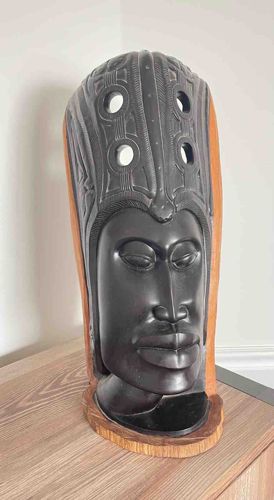
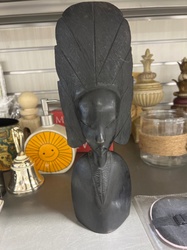
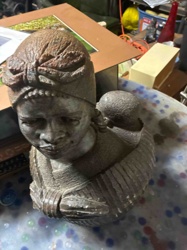
This is a meticulously handcrafted figural sculpture, likely depicting a stylized human head, originating from Tanzania and dated to 1974. The piece measures approximately 19 inches in height, 8 inches in width, and weighs a substantial 11 lbs. It is primarily composed of dark, dense ebony wood for the central head and an elaborate headdress. This dark carving is strikingly contrasted by a lighter, naturally finished wood that forms the elongated backing and a sturdy base. The deep, almost black hue of the ebony highlights the smoothly carved and polished contours of the face, which features a broad forehead, pronounced cheekbones, distinctive thick lips, and serene, downcast eyes, characteristic of traditional African artistry. The most striking element is the highly detailed and intricately carved headdress or elaborate hairstyle, extending upwards and gracefully curving around the head. This headdress is richly adorned with complex geometric patterns, including finely incised lines, hatching, and stylized motifs. Notably, it incorporates four circular openwork cut-outs, two on each side, each encircled by concentric raised rings, adding a unique sculptural dimension and visual lightness. The integration of the dark ebony with the lighter natural wood backing, which is either sapwood from the same log or a skillfully joined contrasting wood, creates a visually dynamic and sophisticated effect, emphasizing the central figure. The base is an irregularly shaped, thick horizontal slice of the lighter wood, showcasing its organic grain and providing stable support. As per the provided context, the item is in excellent condition with no visible damages, cracks, chips, or significant wear, suggesting careful preservation and demonstrating robust, skilled craftsmanship. The smooth finish on the face juxtaposed with the intricate textures of the headdress showcases the artisan's mastery of their medium and exceptional attention to detail. This piece stands as a significant example of mid-20th century Tanzanian handcrafted art, reflective of its cultural heritage and artistic expression.
AI Appraisal Report
Based on my examination of the detailed description provided for this Tanzanian Handcrafted Ebony Wood Head Sculpture, dated 1974, I find it to be a significant example of mid-20th century African artistry. The reported "excellent condition with no visible damages, cracks, chips, or significant wear" is a critical value driver, indicating meticulous preservation. The substantial size (19" H, 11 lbs) and use of dense ebony wood, expertly contrasted with a lighter wood backing and base, underscore its quality and visual appeal. The craftsmanship, particularly the intricate headdress with its geometric patterns and openwork cut-outs, demonstrates a high level of artistic skill and attention to detail.
In the market for African tribal art, well-preserved, large-scale, and aesthetically striking pieces of known origin like this command sustained interest. While specific artist attribution is absent, the quality points to a skilled artisan. Comparisons with similar mid-20th century ebony carvings of this caliber suggest a strong valuation. Demand for such authentic, handcrafted items is consistent, and this piece's excellent condition and unique blend of materials and design contribute to its relative rarity among general African sculptures.
It is crucial to state that this appraisal is based entirely on the provided textual description. A definitive authenticity verification and precise condition assessment would require in-person examination to confirm the ebony wood, detect any subtle repairs, assess the true patina, and verify dimensions/weight. Provenance documentation (e.g., acquisition history) and potentially scientific testing (e.g., wood dating, species identification) would further solidify authenticity and maximize value. Consultation with a specialist in Tanzanian art would also be beneficial for stylistic nuances.