AI estimate as of August 26, 2025 · verify with a professional before acting
AI-Generated · Verify before acting
Everything on this page is generated by AI for informational purposes only. AI can make mistakes — the AI may misidentify items or misattribute them (artist, maker, brand, designer, origin, era). This is not an official valuation and should not be used for insurance, sale, tax, estate, legal, or lending purposes — or any decision requiring a certified appraisal. It is not an authoritative claim about any person, brand, or rights holder — do not share or rely on it as a factual statement about a third party. Always consult qualified professionals before making financial decisions.
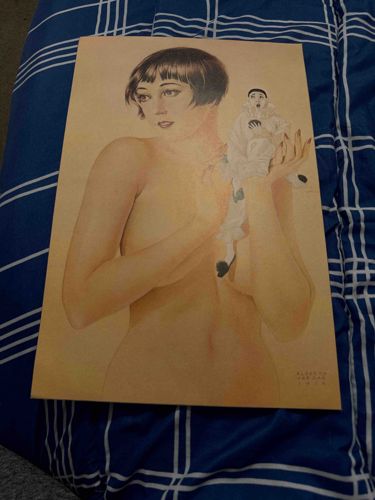
The item is a reproduction of a famous Art Deco-era illustration, specifically 'The Doll' by Alberto Vargas from 1928. It depicts a bare-breasted woman with a bob haircut, characteristic of the flapper style, holding a Pierrot figure or clown doll. The woman's skin tone is rendered in muted, warm tones (likely sepia or light beige), typical of Vargas's early work and print reproductions from that period. Her hair is dark, and her facial features are subtly defined, with a gaze directed slightly off-center. The Pierrot doll, held delicately in her hands, is predominantly white with black details, suggesting a classic clown costume. The print appears to be on a heavy stock paper, given its rigidity and flat lay. There are no significant visible condition issues such as major tears, creases, or extensive discoloration beyond the overall aged patina of the paper, if any. The colors are soft and appear well-preserved, not overly vibrant, which is consistent with reproductions of artworks from the early 20th century. In the bottom right corner, there are discernible markings that appear to be the artist's signature 'ALBERTO VARGAS' and the year '1928', confirming its origin and approximate age. The print exhibits the distinctive soft glamour and elegance associated with Vargas's pin-up art, which bridges realism and idealized form. The craftsmanship is indicated by the fine detail in the rendering of both figures and the delicate balance of the composition, typical of high-quality lithographic or rotogravure printing methods used for art reproductions of this period.
AI Appraisal Report
I have examined the provided image of 'The Doll' by Alberto Vargas, a reproduction print from 1928. Visually, the print appears to be in very good condition for its age, showcasing soft, well-preserved colors and no apparent major tears, creases, or significant discoloration. The discernible 'ALBERTO VARGAS 1928' signature and date align with known reproductions of his work from that period. The soft glamour and fine detail are characteristic of Vargas's style and suggest a high-quality reproduction method, such as lithography or rotogravure. The use of muted, warm tones for the skin and the overall composition are consistent with Vargas's Art Deco-era illustrations.
Market conditions for vintage Alberto Vargas reproduction prints remain steady, driven by collectors of pin-up art, Art Deco enthusiasts, and Vargas aficionados. While original Vargas watercolors or paintings command significant values, reproduction prints are more accessible. Comparables for similar high-quality, period reproductions of Vargas's early work typically range based on condition and rarity. 'The Doll' is a recognizable and desirable image, contributing to its demand. Its apparent excellent condition for a nearly 100-year-old print enhances its value.
Factors significantly impacting value include the print's consistent color, lack of significant damage, and the clear artist's signature and date. However, my assessment of authenticity is limited by visual examination alone. To definitively verify authenticity and fully assess its condition, a physical in-person examination would be crucial. This would allow for an assessment of paper type, printing technique (e.g., halftone dots for lithography), and any subtle damage not visible in the image. Provenance documentation, detailing the print's ownership history, would provide additional support for its authenticity. Scientific testing, such as ink analysis, would be necessary for absolute authentication as an original period print. Without these, it is difficult to distinguish a true 1928 period reproduction from a later, high-quality reprint.