AI estimate as of September 9, 2025 · verify with a professional before acting
AI-Generated · Verify before acting
Everything on this page is generated by AI for informational purposes only. AI can make mistakes — the AI may misidentify items or misattribute them (artist, maker, brand, designer, origin, era). This is not an official valuation and should not be used for insurance, sale, tax, estate, legal, or lending purposes — or any decision requiring a certified appraisal. It is not an authoritative claim about any person, brand, or rights holder — do not share or rely on it as a factual statement about a third party. Always consult qualified professionals before making financial decisions.
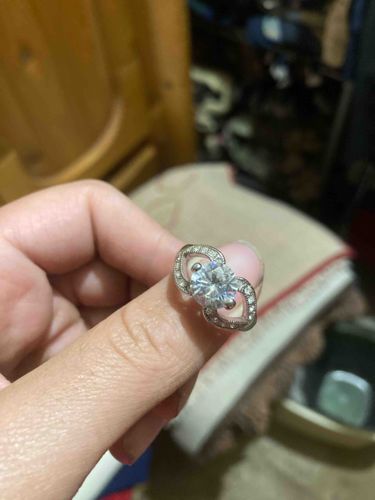
This is a silver-toned metal ring, likely made of sterling silver or a similar alloy, featuring a prominent round faceted clear stone at its center. The central stone appears to be a brilliant cut, exhibiting significant sparkle and a diameter that suggests it could be a diamond simulant (such as cubic zirconia) or a naturally occurring gemstone like a white sapphire or topaz, though specifics cannot be confirmed from the image alone. The stone is set within a bezel or possibly a partial bezel mounting that allows for maximum light exposure. Flanking the central stone are two openwork, undulating or 'S'-shaped bands that are pavé-set with numerous smaller clear stones. These smaller stones appear round and are also faceted, contributing to the overall brilliance of the piece. The metal exhibits a polished, reflective finish, typical of new or well-maintained jewelry. There are no immediately obvious signs of excessive wear, scratches, or significant damage to either the metal or the stones, suggesting the item is in good to excellent visible condition. The craftsmanship appears to be of reasonable quality, with the stones appearing evenly set. No discernible maker's marks or hallmarks are visible in the provided image. The design leans towards a contemporary or possibly late 20th to early 21st century aesthetic, characterized by its modern curves and emphasis on sparkle. The ring's design suggests it could function as a fashion ring or possibly an engagement/commitment ring alternative.
AI Appraisal Report
Based on my visual examination of the provided image, this silver-toned ring is in excellent visible condition, showing a polished finish and no obvious signs of wear, scratches, or damage to the metal or stones. The prominent central round faceted clear stone, flanked by smaller pavé-set stones on undulating bands, creates a striking and sparkling aesthetic. Given the lack of visible hallmarks and the bright, consistent sparkle of the stones, it is highly probable that the central stone is a diamond simulant, such as cubic zirconia (CZ), or possibly a synthetic white sapphire, rather than a natural diamond. Similarly, the smaller accent stones are likely CZ or similar man-made clear stones.
Market conditions for fashion jewelry featuring simulants in silver-toned metals are generally robust, with high demand for accessible sparkle. However, the supply is also very high, limiting individual item value. This piece's value is primarily decorative, driven by its attractive design and visual appeal rather than intrinsic material worth. Factors impacting value include the type of metal (sterling silver would fetch a higher price than a base metal alloy), and the quality of the simulants. Without physical examination, I cannot confirm the metal content or precisely identify the stones; genuine sterling silver would raise the value towards the higher end of the range. Its rarity is low, as similar designs are common.
My appraisal is limited by the inability to perform in-person authentication or testing. A definitive appraisal would require in-hand examination to verify: 1) Metal composition and precious metal hallmarks (e.g., '925' for sterling silver), 2) Gemstone identification (e.g., using a diamond tester, refractive index tests, or spectroscopic analysis to differentiate between diamond, CZ, moissanite, or other simulants), and 3) Assessment of overall craftsmanship, stone setting security, and any hidden condition issues. Provenance documentation, if available, would also provide valuable context.