AI estimate as of August 11, 2025 · verify with a professional before acting
AI-Generated · Verify before acting
Everything on this page is generated by AI for informational purposes only. AI can make mistakes — the AI may misidentify items or misattribute them (artist, maker, brand, designer, origin, era). This is not an official valuation and should not be used for insurance, sale, tax, estate, legal, or lending purposes — or any decision requiring a certified appraisal. It is not an authoritative claim about any person, brand, or rights holder — do not share or rely on it as a factual statement about a third party. Always consult qualified professionals before making financial decisions.
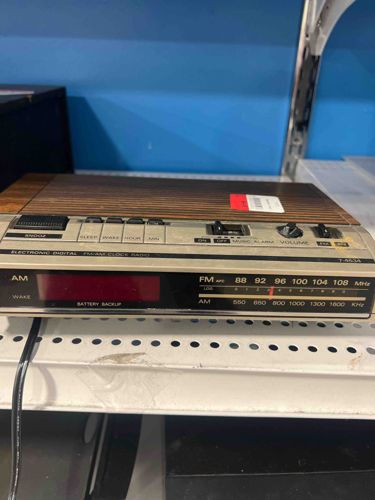
This is a vintage Electronic Digital FM-AM Clock Radio. It features a rectangular form factor with a multi-material construction. The top surface appears to be a wood-grain patterned plastic or laminate, possibly mimicking a faux wood veneer, with prominent ribbed detailing running horizontally. The front panel is made of a beige or off-white plastic, contrasting with a darker, likely black, recessed section where the digital time display and radio tuning dial are located. The digital display is a red LED type, common in electronics from the 1970s and 80s, and shows 'AM' and 'WAKE' indicators, along with 'BATTERY BACKUP' text. To the right of the digital display is an analog tuning dial for FM and AM frequencies, marked with typical radio station numbers (e.g., FM: 88-108 MHz, AM: 550-1600 KHz). The top control panel includes several push-buttons labeled 'SNOOZE', 'SLEEP', 'WAKE', 'HOUR', and 'MIN', indicating its alarm and sleep functions. There are also rotary knobs, one clearly labeled 'VOLUME', and another for 'MUSIC ALARM' settings, along with toggle switches. A red retail sticker is visible on the top wood-grain patterned surface, suggesting it is being sold in a thrift store or similar retail environment. The overall condition shows signs of use and age, including some discoloration and minor scuffs on the plastic casing, consistent with an older electronic item. The style strongly suggests a mid to late 20th-century aesthetic, likely 1970s or 1980s.
AI Appraisal Report
Upon my virtual examination of the Electronic Digital FM-AM Clock Radio, my assessment of its condition is fair to good, considering its age. The visual cues, such as the red LED display and analog tuning dial, strongly indicate an authenticity consistent with late 1970s to early 1980s electronics. The wood-grain patterned plastic and beige casing, along with the ribbed detailing, are hallmark design elements of that era. There are clear signs of use and age, including discoloration and minor scuffs, which are typical for an item of this vintage. The presence of a retail sticker suggests it is currently in a resale market, likely a thrift or second-hand store.
From a market conditions perspective, vintage clock radios are not typically high-demand collectibles unless they possess unique design features, historical significance, or exceptional rarity, which this piece does not appear to have. Comparables in similar condition from this period generally sell for modest sums. While there's a niche market for retro electronics, this particular model does not stand out as being particularly sought after. Its universal function and relatively common design limit its rarity.
Factors significantly impacting its value include its common design, visible wear, and the fact that it is a ubiquitous consumer electronic from its time. The 'BATTERY BACKUP' text and 'AM' and 'WAKE' indicators are standard features, not adding unique value. The red retail sticker itself, while indicating its current sales environment, does not influence its inherent value.
It is crucial to note the limitations of authenticity verification from images alone. I can confirm its apparent age and stylistic authenticity, but I cannot verify its operational condition (i.e., if the clock, radio, or alarm functions work) nor rule out internal modifications or repairs. For full authentication and a more precise valuation, an in-person examination would be required to test functionality, assess internal components for originality, and thoroughly inspect the physical condition without the limitations of photographic representation. Provenance documentation, though unlikely for such an item, would confirm its history, but it is not typically a factor for items of this commonality.