AI estimate as of November 29, 2025 · verify with a professional before acting
AI-Generated · Verify before acting
Everything on this page is generated by AI for informational purposes only. AI can make mistakes — the AI may misidentify items or misattribute them (artist, maker, brand, designer, origin, era). This is not an official valuation and should not be used for insurance, sale, tax, estate, legal, or lending purposes — or any decision requiring a certified appraisal. It is not an authoritative claim about any person, brand, or rights holder — do not share or rely on it as a factual statement about a third party. Always consult qualified professionals before making financial decisions.
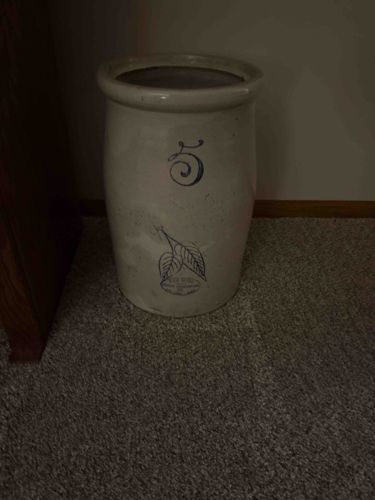
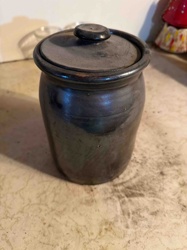
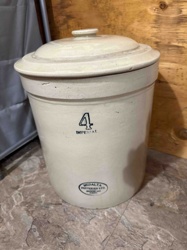
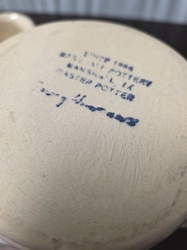
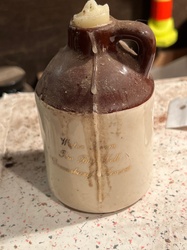
This is an antique salt-glazed stoneware crock, likely dating from the late 19th to early 20th century. The crock is cylindrical with a slightly narrower base and a flared rim at the top, consistent with traditional utilitarian stoneware. Its primary color is a light, natural gray-beige, characteristic of salt-glazed pottery, with a subtle sheen that suggests a smooth, non-porous finish. The most striking features are the cobalt blue decorations: a prominent, stylized '5' – indicating its five-gallon capacity – and a hand-painted floral or foliate motif beneath it, possibly a branch with leaves. Below the leaves, there appears to be a faint, obscured maker's mark or stamp in cobalt blue, which is difficult to fully decipher from the image but could contain a manufacturer's name or location. The craftsmanship suggests a handmade or semi-industrial production typical of the period, with slight irregularities indicating its age and the firing process. Visible condition issues include general surface grime and potential discoloration, which is typical for items of this age and long-term use. There are no immediately obvious chips or cracks, but a thorough inspection would be required to confirm this. The interior appears darker, possibly from use or shadowing. The overall aesthetic is rustic and functional, reflecting its original purpose for food storage or fermentation.
AI Appraisal Report
Based on my examination of the image of this antique 5-gallon salt-glazed stoneware crock, I assess its condition as good vintage, consistent with its likely late 19th to early 20th-century origin. The salt-glaze finish appears intact, and the characteristic natural gray-beige coloration with subtle sheen is present. The most appealing features are the vibrant cobalt blue decorations, including the prominent '5' and the hand-painted floral/foliate motif. The presence of a faint, obscured maker's mark suggests authenticity, characteristic of period utilitarian stoneware. While general surface grime and discoloration are evident, which is typical for an item of this age and long-term use, I don't observe any immediately obvious chips, cracks, or significant structural damage from the image. However, a thorough in-person inspection would be crucial to confirm the absence of hairline cracks, repairs, or more subtle wear that could affect value.
In terms of market conditions, large capacity salt-glazed crocks with cobalt decoration are consistently sought after by collectors of American stoneware, folk art, and early Americana. The floral motif adds a level of decorative appeal beyond purely utilitarian pieces, contributing to demand. While 5-gallon crocks are not exceedingly rare, pieces with well-preserved and distinctive cobalt decoration, especially floral designs or clear maker's marks, command higher prices. Comparables typically range from $200-$700 depending on condition, decoration intricacy, and maker's identification. The inability to fully decipher the maker's mark is a limiting factor; a recognizable maker could significantly increase value.
My appraisal value of $300-500 reflects good overall visual condition and desirable cobalt decoration, offset by the inability to confirm the maker and the exact condition without physical inspection. For full authentication and a more precise valuation, I would recommend a physical examination to check for firing flaws, chips, cracks (especially along the rim and base), repairs, and to attempt to identify the maker's mark under magnification. Provenance documentation, if available, would also be invaluable in confirming its history and authenticity.