Late 19th Century Mouth-Blown Medicine Bottle
Antique Glassware / Apothecary Collectibles

Late 19th Century Mouth-Blown Medicine Bottle

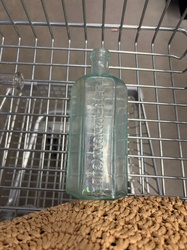
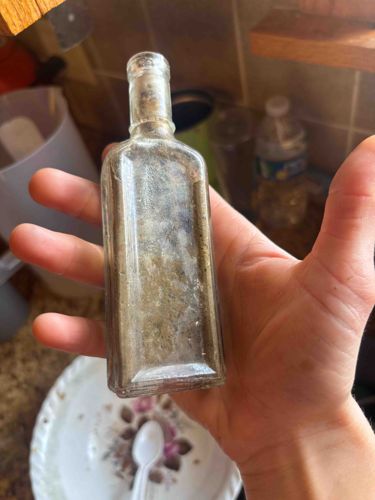
This is a rectangular, transparent glass medicine bottle, likely dating from the late 19th to early 20th century. The vessel features a tall, narrow neck with a hand-applied tooled finish/lip, indicating it was mouth-blown into a mold (BIM). The body has flat sunken panels on all four sides, a common design intended for paper labels or embossed apothecary branding. At approximately 5-6 inches in height, the glass exhibits a slight grayish or straw tint, likely due to naturally occurring impurities or the use of manganese as a decoloring agent. A notable physical feature is the heavy 'sick glass' iridescent patina or burial oxidation covering the surface, which gives the glass a cloudy, mottled appearance from being underground for a long period. No specific maker's marks are visible in the primary image, but the manufacturing technique suggests a post-Civil War era (c. 1880-1910). The condition is typical for a dug bottle, showing significant interior and exterior scaling and mineralization without obvious cracks or chips.
Estimated Value

$15.00 - $25.00

Basic Information

Category

Antique Glassware / Apothecary Collectibles

Appraised On

March 7, 2026

Estimated Value

$15.00 - $25.00

Item Description

This is a rectangular, transparent glass medicine bottle, likely dating from the late 19th to early 20th century. The vessel features a tall, narrow neck with a hand-applied tooled finish/lip, indicating it was mouth-blown into a mold (BIM). The body has flat sunken panels on all four sides, a common design intended for paper labels or embossed apothecary branding. At approximately 5-6 inches in height, the glass exhibits a slight grayish or straw tint, likely due to naturally occurring impurities or the use of manganese as a decoloring agent. A notable physical feature is the heavy 'sick glass' iridescent patina or burial oxidation covering the surface, which gives the glass a cloudy, mottled appearance from being underground for a long period. No specific maker's marks are visible in the primary image, but the manufacturing technique suggests a post-Civil War era (c. 1880-1910). The condition is typical for a dug bottle, showing significant interior and exterior scaling and mineralization without obvious cracks or chips.

Get Your Items Appraised

Instant estimates of your treasures with AI-powered instant appraisals

Browse More Appraisals