AI estimate as of October 4, 2025 · verify with a professional before acting
AI-Generated · Verify before acting
Everything on this page is generated by AI for informational purposes only. AI can make mistakes — the AI may misidentify items or misattribute them (artist, maker, brand, designer, origin, era). This is not an official valuation and should not be used for insurance, sale, tax, estate, legal, or lending purposes — or any decision requiring a certified appraisal. It is not an authoritative claim about any person, brand, or rights holder — do not share or rely on it as a factual statement about a third party. Always consult qualified professionals before making financial decisions.
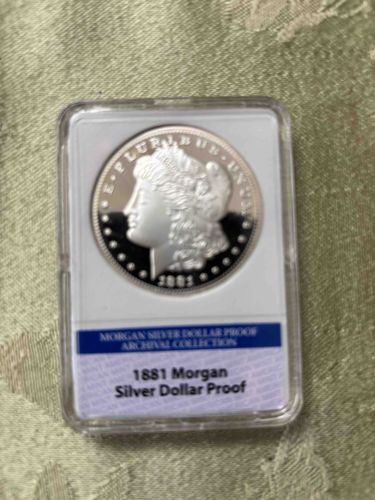
The item is a commemorative proof coin, clearly labeled as an '1881 Morgan Silver Dollar Proof' and part of an 'Archival Collection.' It is encased in a transparent, rectangular plastic slab, a common method for protecting and presenting collectible coins. The coin itself features the classic obverse design of the Morgan Dollar, depicting a left-facing profile of Lady Liberty. Her hair is intricately detailed, adorned with a wreath and a small cap. The inscription 'E PLURIBUS UNUM' is visible along the top rim, and the date '1881' is prominently displayed at the bottom. The background field of the coin appears to have a highly reflective, mirror-like finish, characteristic of a proof strike, contrasting sharply with the frosted or matte finish of Lady Liberty's portrait. A ring of small dots forms an inner border around the main design on the obverse. While the reverse is not visible, it would typically feature an eagle with outstretched wings. The protective slab has a blue and white label at the bottom with the aforementioned descriptive text. The entire presentation suggests a high-quality, likely modern strike or reproduction intended for collectors rather than an original circulating coin. The coin is in pristine condition, showing no visible wear, scratches, or tarnishing, which is expected for a proof coin in its original sealed holder. The craftsmanship appears to be of high quality, replicating the details of the original Morgan Dollar design with precision. It is designed to preserve the coin's condition and authenticate its details.
AI Appraisal Report
I have examined the provided image of the 1881 Morgan Silver Dollar Proof, housed within a protective slab labeled as part of an 'Archival Collection.' My visual assessment indicates the coin is in pristine condition, exhibiting no signs of wear, scratches, or tarnishing, which is consistent with a proof strike maintained in its original holder. The highly reflective field contrasted with the frosted portrait of Lady Liberty is a hallmark of a proof coinage. The details, such as Liberty's hair and the inscriptions, appear sharply struck, indicative of high-quality craftsmanship.
authenticity is the primary concern here. While the coin's appearance is consistent with a proof Morgan Dollar, the 'Archival Collection' designation on the slab is a significant red flag. This phrasing often accompanies modern restrikes, reproductions, or privately minted commemoratives that resemble historical coins but are not genuine U.S. Mint productions. True authenticated Morgan Dollar Proofs from 1881, especially in high grades, are exceedingly rare and encapsulated by recognized third-party grading services like PCGS or NGC, not generically labeled 'Archival Collection.'
Market conditions for genuine 1881 Proof Morgan Dollars are robust, with values ranging from several thousands to tens of thousands of dollars depending on the specific proof designation and grade. However, for items like the one presented, assumed to be a modern commemorative or reproduction given the 'Archival Collection' label, demand is significantly lower, driven more by numismatic novelty than historical scarcity or intrinsic metal value.
Factors significantly impacting value are primarily its likely status as a reproduction versus an authentic original U.S. Mint proof. The lack of standard third-party grading service authentication heavily diminishes its perceived value as a historical artifact.
Limitations in authenticity verification from images alone are substantial. Without physical inspection, I cannot confirm the metallic composition (e.g., actual silver content), weight, or edge characteristics. Most crucially, without a reputable third-party grading service slab, the authenticity as an original U.S. Mint proof cannot be confirmed. For full authentication, in-person examination by a professional numismatist, verification of the coin's specific gravity and metallic composition, and provenance documentation linking it to a legitimate minting source would be essential. Assuming it's a high-quality reproduction, the value lies in its aesthetic appeal and the silver content, if sterling, rather than its historical coinage status. Therefore, my appraisal reflects this likely scenario.