These notes were written by the person who submitted this item. Appraiser.AI has not verified them, and the AI's identification and estimate may rely on them.
AI Estimated Value
Not an official valuation
$600-900
AI estimate as of July 10, 2025 · verify with a professional before acting
AI-Generated · Verify before acting
Everything on this page is generated by AI for informational purposes only. AI can make mistakes — the AI may misidentify items or misattribute them (artist, maker, brand, designer, origin, era). This is not an official valuation and should not be used for insurance, sale, tax, estate, legal, or lending purposes — or any decision requiring a certified appraisal. It is not an authoritative claim about any person, brand, or rights holder — do not share or rely on it as a factual statement about a third party. Always consult qualified professionals before making financial decisions.
This analysis also relies on unverified notes provided by the user, which may be incomplete or inaccurate and could affect the result.
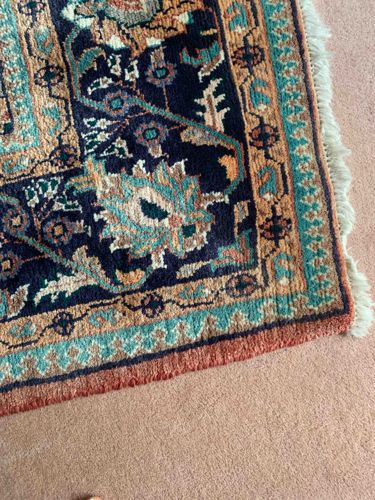
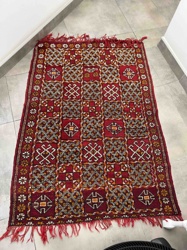
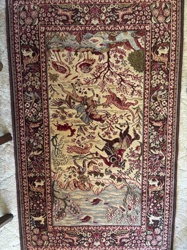
This item is identified as a large wool area rug, specified as 10'x14' in size. The rug features a richly detailed traditional or oriental design, with a dominant color palette of primary navy blue, beige/tan, and various shades of teal/aqua, complemented by accents of rust orange and touches of brown and lighter cream. The pattern appears intricate, likely consisting of floral motifs, palmettes, and vine work characteristic of Persian or similar regional rug designs. The main field of the rug is deep navy blue, acting as a backdrop for the lighter-colored medallions and curvilinear patterns. A prominent border frames the main field, consisting of multiple bands displaying smaller, repetitive geometric or stylized floral elements in contrasting colors like teal, beige, and rust. The rug is constructed from wool, evident from the dense, plush pile and the visible texture. The edges show a clearly defined fringe in a natural, light color, suggesting it's likely cotton or a similar material, and the sides appear securely bound, possibly with overcasting in a coordinating color like rust. The overall condition appears to be relatively good with a consistent pile, though some slight compression or unevenness might be present due to use. The colors seem rich and unfaded, indicating good dye quality or satisfactory preservation. No significant visible damage such as tears, major wear spots, or extensive repairs are immediately apparent from the provided image. The style suggests it could be a machine-made imitation of a hand-knotted rug due to the uniformity of the weave visible at the pile's surface; however, without seeing the reverse side, it's difficult to confirm. Its aesthetic points towards a late 20th or early 21st-century production, aiming for a classic and enduring look suitable for various interior designs. The rug exhibits good craftsmanship through its detailed patterning and seemingly robust construction.
AI Appraisal Report
I have examined the provided image of this 10'x14' wool area rug. Visually, the rug presents in relatively good condition with rich, unfaded colors and a seemingly consistent, dense pile. The intricate traditional design, with its dominant navy blue and beige/tan palette accented by teal and rust, is aesthetically pleasing and aligns with popular home decor trends. The construction appears robust, and the clean fringe and bound edges indicate good care or manufacturing quality.
Based on the uniform appearance of the pile and pattern without discernible knot variations typical of hand-knotted pieces, I strongly suspect this is a high-quality machine-made wool rug, likely originating from the late 20th or early 21st century. While it successfully emulates the look of a traditional Persian rug, it lacks the unique irregularities and labor intensity of a true hand-knotted antique or semi-antique piece. This distinction significantly impacts value.
The market for large machine-made wool rugs of this type is robust, driven by demand for durable and decorative floor coverings that offer the aesthetic of traditional designs at a more accessible price point. Comparables would include mass-produced rugs from reputable manufacturers known for quality wool products. Demand is consistent, but rarity is not a factor for machine-made goods.
The primary factor impacting value is its likely machine-made construction. If it were confirmed as hand-knotted, its value would be considerably higher. Without physical inspection, I cannot confirm the exact fiber content beyond wool (e.g., blend specifics), the precise method of construction (machine-tufted vs. machine-woven), or the presence of any minor wear, stains, or repairs not visible in the image. Examining the reverse side is critical for definitive authenticity and construction verification.