AI estimate as of November 28, 2025 · verify with a professional before acting
AI-Generated · Verify before acting
Everything on this page is generated by AI for informational purposes only. AI can make mistakes — the AI may misidentify items or misattribute them (artist, maker, brand, designer, origin, era). This is not an official valuation and should not be used for insurance, sale, tax, estate, legal, or lending purposes — or any decision requiring a certified appraisal. It is not an authoritative claim about any person, brand, or rights holder — do not share or rely on it as a factual statement about a third party. Always consult qualified professionals before making financial decisions.
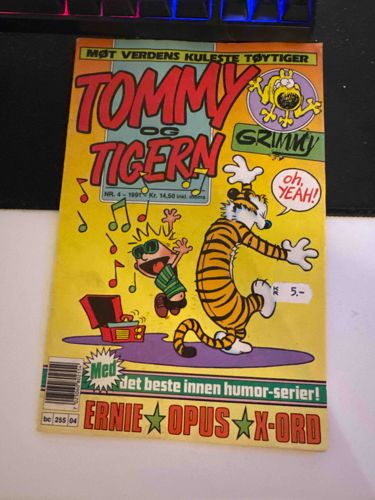
This item is a vintage comic book titled "Tommy og Tigern," which is the Norwegian translation of the popular American comic strip "Calvin and Hobbes." The cover features vibrant colors, predominantly yellow, with illustrations of Calvin (Tommy) dancing enthusiastically with sunglasses and a boombox, while Hobbes (Tigern) is also dancing and exclaiming "oh, YEAH!". The title 'TOMMY OG TIGERN' appears in large, playful red and black lettering. In the upper right corner, there's a smaller image of another cartoon character, likely Grimmy from 'Mother Goose and Grimm,' and the text 'GRIMMY'. The comic book is numbered 'NR. 4-1991', indicating it is the fourth issue from the year 1991. The original price of 'Kr. 14.50' is visible on the cover. A white sticker with '5.-' suggests a reduced or secondary market price at some point. The bottom portion of the cover advertises other humor series, including 'ERNIE', 'OPUS', and 'X-ORD', implying this issue is a collection featuring multiple comic strips. A barcode is also present on the bottom left corner, with 'bc 255 04' printed beneath it. The physical condition appears good for its age, though there might be minor signs of wear typical for a paper item from 1991, such as slight edge wear or minor creasing, which are not clearly visible in this image. The colors remain bright and unfaded. Printed on paper, likely glossy for the cover, the comic book reflects the popular culture of the early 1990s and is a prime example of translated comic strip compilations during that era. Its unique aspect is the Norwegian translation of a universally loved comic, making it a collector's item for fans of 'Calvin and Hobbes' or international comic book collectors.
AI Appraisal Report
Upon visual examination of the provided image, this 'Tommy og Tigern' (Calvin and Hobbes) Nr. 4-1991 comic book appears to be in very good condition for its age. The vibrant cover colors are well-preserved, showing no significant fading, and the paper appears relatively flat, suggesting minimal creasing or spine roll. The original price of 'Kr. 14.50' is clear, and while a '5.-' sticker indicates a past discounted price, it doesn't overly detract from the cover's appeal. Authenticity as a genuine Norwegian translation from 1991 is strongly supported by the title, numbering, and other printed details like 'GRIMMY', 'ERNIE', 'OPUS', and 'X-ORD' on the cover, typical of multi-strip compilations of the era. However, without a physical inspection, I cannot definitively assess minor edge wear, corner dings, interior page quality (e.g., tanning, tears, writing), or the integrity of the spine. Market conditions for foreign-language 'Calvin and Hobbes' compilations are generally moderate. While 'Calvin and Hobbes' is universally popular, translated editions, especially from smaller print runs like Norwegian ones, primarily appeal to niche collectors of international comics or dedicated 'Calvin and Hobbes' completists. Rarity is moderate; these were printed for a specific regional market but are not exceptionally scarce. Demand is likewise moderate within this niche. Key factors impacting value include its good condition (for a 30+ year old paper item) and its connection to a beloved comic strip. A physical examination would be crucial to verify the absence of hidden faults, such as significant internal damage, odors, or restoration, which could alter this appraisal. Provenance documentation is not typically sought for items of this value, and scientific testing is unnecessary.