These notes were written by the person who submitted this item. Appraiser.AI has not verified them, and the AI's identification and estimate may rely on them.
AI Estimated Value
Not an official valuation
$100-200
AI estimate as of July 19, 2025 · verify with a professional before acting
AI-Generated · Verify before acting
Everything on this page is generated by AI for informational purposes only. AI can make mistakes — the AI may misidentify items or misattribute them (artist, maker, brand, designer, origin, era). This is not an official valuation and should not be used for insurance, sale, tax, estate, legal, or lending purposes — or any decision requiring a certified appraisal. It is not an authoritative claim about any person, brand, or rights holder — do not share or rely on it as a factual statement about a third party. Always consult qualified professionals before making financial decisions.
This analysis also relies on unverified notes provided by the user, which may be incomplete or inaccurate and could affect the result.
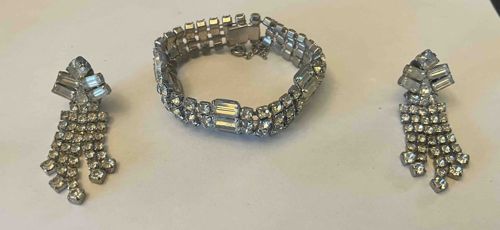
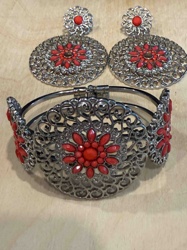
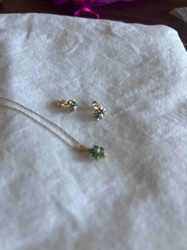
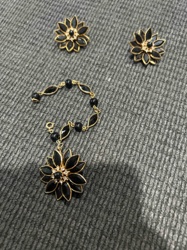
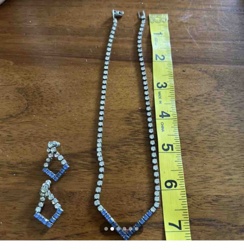
This is a vintage-style costume jewelry set, likely dating from the mid-20th century, possibly the 1940s-1960s, designed to mimic the appearance of diamond and platinum fine jewelry. The set comprises a bracelet and a pair of clip-on earrings. Both pieces are constructed from a silver-toned base metal, likely rhodium-plated for a bright, non-tarnishing finish, and are profusely embellished with clear, colorless rhinestones. The bracelet features a two-row design, with each row consisting of alternating round-cut and baguette-cut rhinestones set in individual, articulated links. This construction allows for flexibility and drape. The securing mechanism appears to be a fold-over clasp with an additional safety chain for added security. The earrings are clip-on style, featuring a bow-like motif at the top composed of baguette-cut rhinestones, from which several cascading strands of round-cut rhinestones dangle. The overall design emphasizes sparkle and an opulent aesthetic without the use of precious gems. The craftsmanship appears to be typical of mass-produced costume jewelry of the era, with stones set securely, though some minor wear or looseness may be present with age. No discernible maker's marks are visible in the provided images. The condition appears good for its age, with some slight darkening or patina in the metal recesses that suggest age, and rhinestones generally intact and sparkling, though some may exhibit minor scratching or dullness characteristic of wear.
AI Appraisal Report
I have carefully examined the provided images of this vintage rhinestone bracelet and clip-on earring set. Based on the visual evidence, this appears to be a well-preserved example of mid-20th-century costume jewelry, likely dating from the 1940s-1960s, consistent with the described construction using silver-toned base metal (likely rhodium-plated) and clear rhinestones. The two-row bracelet with alternating round and baguette cuts, along with the cascading bow-motif earrings, reflects the opulent yet accessible aesthetic of the era, designed to emulate fine diamond jewelry.
From the images, the condition appears good for its age. I note the presence of some minor darkening or patina in metal recesses, which is typical aging for costume jewelry and often desirable as it adds to the vintage character. The rhinestones generally seem intact and retain good sparkle, though as noted, some minor scratching or dullness from wear is to be expected. The construction points to mass production, common for this type of jewelry, and the articulated links suggest reasonable flexibility in the bracelet.
Market conditions for vintage costume jewelry remain steady, with pieces from well-known designers often fetching higher prices. Without discernible maker's marks, this set falls into a broader category of unsigned vintage pieces. While there isn't significant rarity, the complete matching set enhances its desirability. Demand for wearable, sparkling vintage costume jewelry for special occasions or collecting is consistent. Factors significantly impacting value include the integrity of the rhinestones, the condition of the plating, and the completeness of the set. The absence of major stone loss or irreparable damage is a plus.
Crucially, my assessment of authenticity and condition is based solely on the provided images. A definitive authentication and more precise condition assessment would require in-person examination. Specifically, I would need to inspect the settings for any loose stones, check the security of the clasp and earring clips, and use a loupe to assess the quality of the rhinestones for chips, scratches, and foil degradation. Testing the metal for composition (e.g., rhodium plating) and searching for any faint or hidden maker's marks would also be part of a full, in-person appraisal. Provenance documentation, if available, could also add to the item's historical context and potentially value.