These notes were written by the person who submitted this item. Appraiser.AI has not verified them, and the AI's identification and estimate may rely on them.
AI Estimated Value
Not an official valuation
$150-250
AI estimate as of October 12, 2025 · verify with a professional before acting
AI-Generated · Verify before acting
Everything on this page is generated by AI for informational purposes only. AI can make mistakes — the AI may misidentify items or misattribute them (artist, maker, brand, designer, origin, era). This is not an official valuation and should not be used for insurance, sale, tax, estate, legal, or lending purposes — or any decision requiring a certified appraisal. It is not an authoritative claim about any person, brand, or rights holder — do not share or rely on it as a factual statement about a third party. Always consult qualified professionals before making financial decisions.
This analysis also relies on unverified notes provided by the user, which may be incomplete or inaccurate and could affect the result.
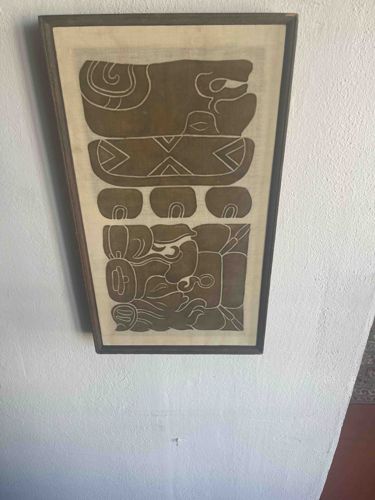
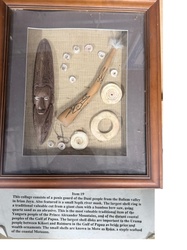
This item is a framed piece of artwork, likely an Amate bark painting, featuring stylized indigenous iconography. The artwork is presented in a simple, rectangular wooden frame with a dark brown finish, suggesting natural wood or a stained treatment. The visual surface of the artwork appears to be a light, off-white or cream-colored paper or bark base, upon which the design is rendered in a dark, earthy brown color. The design itself is composed of bold, graphic outlines that create distinct shapes and figures, possibly representing deities, animals, or symbolic elements from Mesoamerican or similar tribal cultures.
Key features of the design include a prominent head-like figure at the top with large eyes and a curved 'snout' or mouth, characterized by swirling lines and geometric patterns. Below this, there's a horizontal band with 'X' and 'V' patterns, flanked by triangles, suggesting abstract decorative motifs. Further down, there are multiple semi-circular or U-shaped elements arranged in a row, followed by a more complex, interlocking design at the bottom, which seems to depict another anthropomorphic or zoomorphic figure with flowing lines and smaller geometric details. The lines outlining the figures are consistently thick and clean, indicating a deliberate and skilled hand.
The overall condition appears good, with no obvious major damage like tears or severe discoloration visible from the image. The materials suggest it may be a modern or mid-20th-century interpretation of ancient art forms, crafted for decorative purposes. The slight unevenness or texture of the background material hints at it being a natural fiber like Amate bark, known for its use in Mexican folk art. The craftsmanship is solid, with a clear execution of the stylized forms. The framing is utilitarian, serving to protect and display the artwork without distracting from it.
AI Appraisal Report
I have examined the provided image of this framed artwork, which appears to be an Amate bark painting with indigenous iconography. Visually, the condition appears good, with no obvious tears, significant discoloration, or major damage visible. The artwork presents a stylized design rendered in a dark, earthy brown on a light, off-white bark-like substrate, consistent with Amate bark. The lines are bold and clean, indicating competent craftsmanship.
Authenticity is difficult to ascertain definitively from images alone. While the style is consistent with decorative Amate bark paintings often produced in Mexico, particularly for the tourist and folk art markets, I cannot confirm its exact origin, age, or specific tribal attribution without physical inspection. It seems to be a modern or mid-20th-century decorative piece rather than an ancient artifact.
Currently, the market for such decorative Amate bark paintings is steady but not particularly high-value. Comparables typically sell in the range of $50 to $300, depending on size, artistic quality, and specific provenance. The framing is utilitarian and does not add significant value beyond presentation. Demand is primarily from collectors of folk art, Mexican handicrafts, or those seeking decorative pieces with an ethnic aesthetic. Rarity is not a significant factor here, as many such pieces were produced.
The primary factor impacting value is its decorative appeal and perceived artistic merit, rather than historical or anthropological significance, unless further provenance can be established. For full authentication and to ascertain a more precise age and origin, an in-person examination by a specialist in Mesoamerican or Mexican folk art, along with any available provenance documentation, would be crucial. Scientific testing, such as carbon dating on the bark or pigment analysis, could also provide definitive answers regarding its age and materials.