These notes were written by the person who submitted this item. Appraiser.AI has not verified them, and the AI's identification and estimate may rely on them.
AI Estimated Value
Not an official valuation
$150-250
AI estimate as of July 4, 2025 · verify with a professional before acting
AI-Generated · Verify before acting
Everything on this page is generated by AI for informational purposes only. AI can make mistakes — the AI may misidentify items or misattribute them (artist, maker, brand, designer, origin, era). This is not an official valuation and should not be used for insurance, sale, tax, estate, legal, or lending purposes — or any decision requiring a certified appraisal. It is not an authoritative claim about any person, brand, or rights holder — do not share or rely on it as a factual statement about a third party. Always consult qualified professionals before making financial decisions.
This analysis also relies on unverified notes provided by the user, which may be incomplete or inaccurate and could affect the result.
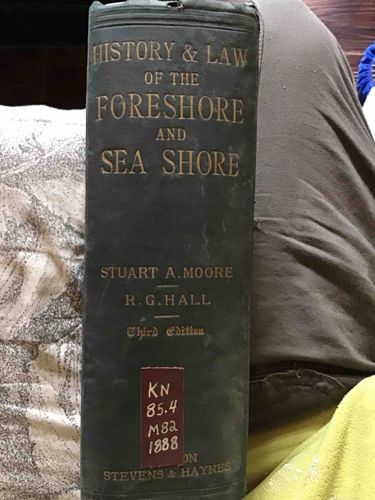
This item is an antique legal treatise titled "History & Law of the Foreshore and Sea Shore," authored by Stuart A. Moore and R.G. Hall. The image clearly indicates it is a \"Third Edition\" published in 1888 by Stevens & Haynes. The book features a dark, possibly black or very dark green, hard cover, which appears to be made of cloth or buckram, typical for legal and scholarly texts of the late 19th century. The spine displays the title, authors, and publisher in gilt lettering, which is still largely legible, indicating good preservation. There is a red label, likely applied by a library or previous owner, with \"KN 85.4 M82 1888\" handwritten or printed on it, which strongly suggests a library call number (possibly Library of Congress classification, given the 'KN' for Law). The book appears to be in good condition, with minimal visible wear, consistent with the provided context. There are slight signs of edge wear at the top and bottom of the spine, and possibly some minor scuffing on the surface, but no major tears, creases, or discoloration. The binding seems intact, with the book maintaining a rigid, rectangular form. The overall quality of craftsmanship would have been standard for academic publications of its era, prioritizing durability and legibility over ornate decoration. Its age and specific subject matter, pertaining to property law and coastal boundaries, make it a notable historical legal document.
AI Appraisal Report
Upon examining the image of "History & Law of the Foreshore and Sea Shore, Third Edition (1888)" by Moore and Hall, I assess its condition as good. The dark hard cover, likely cloth or buckram, appears sturdy with largely legible gilt lettering on the spine, indicating good preservation for its age. While I noted slight edge wear on the spine and potential minor scuffing, there are no major tears or discoloration visible. The binding seems intact, maintaining a rigid form. The presence of a library call number suggests it was a well-maintained institutional copy, which often implies careful handling over decades.
From a market perspective, antique legal treatises like this have a niche demand. While not broadly sought after, collectors of legal history, property law, or maritime law, as well as academic institutions, would find this item appealing. Rarity is moderate; while a specific third edition from 1888 isn't unique, copies in good condition, particularly institutional ones, are not exceptionally common. Comparable sales for similar late 19th-century legal texts in good condition generally range from $100 to $300, depending on the specific subject matter and author's prominence. The focus on foreshore and seashore law is quite specific, adding to its academic rather than general historical appeal.
Factors significantly impacting value include its good condition, the intact binding, and the clear legibility of the spine. The library mark, while indicating good care, might slightly deter collectors who prefer unadulterated copies, but it also confirms authenticity.
It is imperative to state the limitations of an appraisal based solely on images. I cannot definitively verify authenticity without a physical examination. Key aspects requiring in-person inspection include: confirming the paper quality, checking for foxing or internal staining, assessing binding tightness, and verifying the presence of all pages including title pages and colophons. Provenance documentation, beyond the visible library mark, would further enhance authentication (e.g., records of acquisition). Scientific testing would be overkill for a book of this type and value.