AI estimate as of July 20, 2025 · verify with a professional before acting
AI-Generated · Verify before acting
Everything on this page is generated by AI for informational purposes only. AI can make mistakes — the AI may misidentify items or misattribute them (artist, maker, brand, designer, origin, era). This is not an official valuation and should not be used for insurance, sale, tax, estate, legal, or lending purposes — or any decision requiring a certified appraisal. It is not an authoritative claim about any person, brand, or rights holder — do not share or rely on it as a factual statement about a third party. Always consult qualified professionals before making financial decisions.
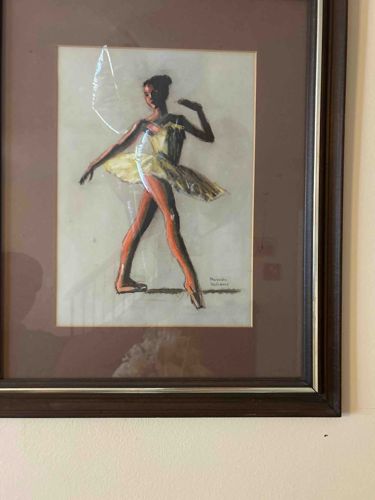
The item is a framed original artwork, likely a pastel or charcoal drawing, depicting a ballerina in a classical pose. The ballerina is rendered with dark, possibly brown or black, hair pulled back into a bun, and a lithe figure. Her skin tone is depicted with warm, reddish-brown hues, giving the impression of strong lighting or a specific artistic style. She wears a light yellow or cream-colored classical ballet tutu with a fitted bodice and a full, layered skirt that appears to have movement. Her left leg is extended behind her, with her foot en pointe, while her right leg is bent forward, foot flat on the ground, suggesting a transition in movement. Her arms are gracefully positioned, with her left arm slightly extended forward and her right arm raised and bent at the elbow. The background is a minimalist, light gray or off-white, allowing the figure to stand out. There is what appears to be a signature in the lower right corner, though it is not clearly legible from the image. The artwork is housed within a dark brown wooden frame, possibly walnut or mahogany, with a slightly lighter, perhaps gold or silver, inner fillet that acts as a border between the artwork and the frame itself. A brown mat board surrounds the artwork, providing visual separation and depth. A notable condition issue is a clear plastic film or tear in the protective covering over the top left portion of the artwork, which may be part of the packaging or a damaged protective layer. There are also reflections visible on the glass or protective layer, indicating the presence of a covering. The artwork suggests a mid to late 20th-century style, characterized by a focus on figure study and expressive brushwork.
AI Appraisal Report
I have examined the provided image of the framed ballerina figurative drawing. This appears to be an original pastel or charcoal artwork, depicting a ballerina with notable skill in rendering form and movement. The warm skin tones and expressive style suggest a mid to late 20th-century origin. The presentation, with a dark wooden frame, inner fillet, and brown mat, presents the artwork professionally.
From a condition standpoint, the artwork itself appears to be in good visual condition within the frame. However, there's a significant issue with the protective covering: a clear plastic film or tear is evident in the upper left, which severely detracts from the presentation and potentially compromises the artwork's integrity by allowing dust or moisture ingress. Reflections on the surface further confirm the presence of a protective layer, likely glass or acrylic, which should ideally be clean and free of imperfections. This protective layer issue significantly impacts the immediate display value and would require repair or replacement.
Regarding authenticity, the visible signature in the lower right corner is crucial but illegible from the image. Without a clear view of the signature, definitive artist identification, and thus verification of authenticity, is impossible. My assessment of authenticity is limited to what can be visually inferred; it appears to be a genuine artwork by an artist, but not necessarily a known or highly sought-after one without further identification.
In terms of market conditions, figurative drawings, especially those depicting classical ballet, generally have a steady but not exceptionally robust market, unless by a recognized artist. Comparables for unsigned or unattributed works of this style and medium typically fall within a modest range. Demand exists for decorative art that is aesthetically pleasing and well-executed. Unless the artist is identified as a collectible individual, rarity is not a significant factor here; similar quality works appear regularly on the market.
Factors significantly impacting value are primarily the condition of the protective covering and, most importantly, the clear identification of the artist. The current damaged protective layer immediately devalues the piece as a ready-to-display item. If the artist were identified as a listed or collectible one, the value could increase substantially.
Limitations: A full authentication would necessitate in-person examination to clearly read the signature, assess the medium with certainty (pastel vs. charcoal), and meticulously examine the artwork's surface for any condition issues not visible through the protective layer or reflections. Provenance documentation (prior ownership history) would be essential for tracing the artwork's origin and confirming its identity. Scientific testing, such as pigment analysis or dating techniques, would be overkill unless there was a specific high-value artist attribution requiring verification. Without artist identification or provenance, this remains a decorative artwork.