AI estimate as of August 16, 2025 · verify with a professional before acting
AI-Generated · Verify before acting
Everything on this page is generated by AI for informational purposes only. AI can make mistakes — the AI may misidentify items or misattribute them (artist, maker, brand, designer, origin, era). This is not an official valuation and should not be used for insurance, sale, tax, estate, legal, or lending purposes — or any decision requiring a certified appraisal. It is not an authoritative claim about any person, brand, or rights holder — do not share or rely on it as a factual statement about a third party. Always consult qualified professionals before making financial decisions.
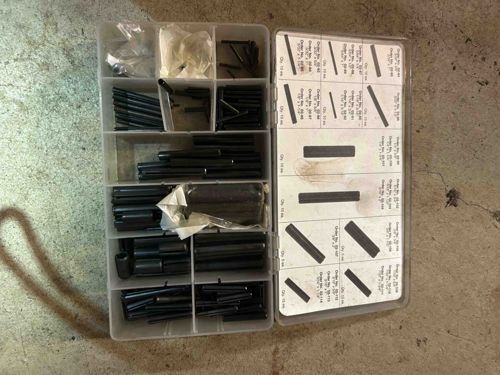
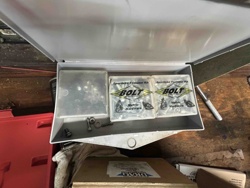
This item is a commercially available assortment kit containing various sizes of what appear to be dowel pins or possibly roll pins, housed within a clear plastic compartmentalized storage case. The pins themselves are uniformly black, suggesting a material like hardened steel with a black oxide finish for corrosion resistance, common for industrial or mechanical applications. The kit includes a wide range of lengths and diameters, organized into multiple rectangular compartments within the clear case. On the right side of the case's lid, there is a printed or adhered label providing specifications for the different pin types, including their dimensions (e.g., 'Ø: 10 mm' and varying lengths denoted as 'L:'). Some sections of these labels show minor discoloration or smudging, indicative of use or age. The pins are generally cylindrical, with some appearing to be solid dowel pins and others possibly slotted roll pins based on the slight visible seams on some examples. The overall condition of the pins appears good, with no obvious signs of rust or significant wear; however, some of the very smallest pins are in small plastic bags within their compartments, presumably to keep them together. The clear plastic case shows typical signs of handling, such as minor scuffs and surface dirt, but no apparent cracks or major structural damage. The compartmentalization is a key feature, allowing for organized storage and easy identification of different pin sizes. This type of kit is commonly used in machinery assembly, repair, and prototyping, where precise alignment and joining of components are required. The craftsmanship seems standard for manufactured hardware items, focusing on dimensional accuracy and utility rather than decorative appeal. The style period is contemporary, as these types of organizational kits and standardized fasteners have been in common use for many decades.
AI Appraisal Report
Based on my visual examination of the provided image, this Assorted Dowel/Roll Pin Kit appears to be a standard, commercially available hardware assortment. The pins' uniform black appearance suggests hardened steel with a black oxide finish, common for durability and corrosion resistance in mechanical applications. The clear compartmentalized case, while showing minor scuffs and surface dirt consistent with use, appears structurally sound. The organized nature and visible label indicating dimensions enhance its utility.
Condition-wise, the pins themselves seem to be in good order, with no evident rust or significant wear. The presence of small pins in plastic bags within compartments is a practical measure for organization, not indicative of damage. The slightly smudged label suggests typical handling.
In terms of market conditions, similar new dowel or roll pin assortment kits from reputable hardware suppliers like McMaster-Carr, Grainger, or specialty fastener companies typically range from $50 to $150, depending on the number of pieces, material, and specific pin types (solid dowels generally being more expensive per piece than roll pins). This kit appears to be a used item, which would naturally depress its value.
Demand for such kits is consistent among hobbyists, small machine shops, maintenance professionals, and DIY enthusiasts. These are not rare items, nor do they possess any unique collectible value. Their value is purely utilitarian. The primary factors impacting value are the completeness of the kit, the exact types and quantities of pins included (which cannot be fully verified from the image alone), and the overall condition of both the pins and the case.
Limitations in authenticity verification are significant from images alone. I cannot definitively confirm the material (e.g., specific steel alloy), hardness, or precise dimensions of the pins without physical inspection and measurement. Nor can I ascertain if the kit is complete as originally sold or if any pins are missing. In-person examination would be required to verify pin type (solid vs. roll), material composition, and to count/measure the contents. Provenance documentation would confirm the manufacturer and original retail price, although this is less critical for a utilitarian item like this.