These notes were written by the person who submitted this item. Appraiser.AI has not verified them, and the AI's identification and estimate may rely on them.
AI Estimated Value
Not an official valuation
$10-30
AI estimate as of August 5, 2025 · verify with a professional before acting
AI-Generated · Verify before acting
Everything on this page is generated by AI for informational purposes only. AI can make mistakes — the AI may misidentify items or misattribute them (artist, maker, brand, designer, origin, era). This is not an official valuation and should not be used for insurance, sale, tax, estate, legal, or lending purposes — or any decision requiring a certified appraisal. It is not an authoritative claim about any person, brand, or rights holder — do not share or rely on it as a factual statement about a third party. Always consult qualified professionals before making financial decisions.
This analysis also relies on unverified notes provided by the user, which may be incomplete or inaccurate and could affect the result.
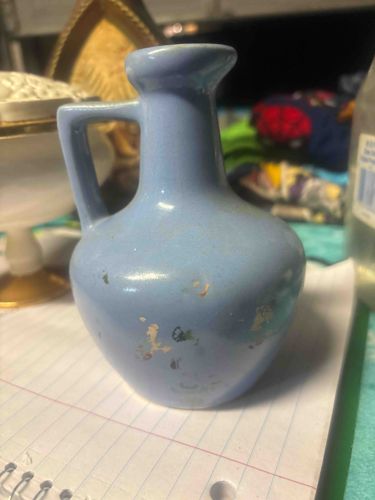
The item is a small, light blue ceramic or porcelain ewer or pitcher. It features a body that swells from a narrower base to a rounded, bulbous mid-section before tapering upwards to a short, flaring neck. The neck has a small pouring spout or lip. On one side, there is a simple, 'D'-shaped handle attached at the neck and the shoulder of the vessel. The color is a consistent, light robin's egg blue with a slightly mottled or speckled texture, possibly indicating a deliberate glaze effect, though some specks appear to be minor imperfections or debris embedded in the glaze. The surface possesses a subtle sheen, suggesting a glazed finish. Notably, there are irregular patches of what appears to be gold or brass-colored paint, some of which are significantly worn or chipped away, revealing the base blue color underneath. These metallic accents suggest a decorative element that has faded over time. There are also small, dark spots, possibly dirt or more precise wear, mixed in with the metallic patches. The overall construction appears sturdy and uniform. Without viewing the base, it's difficult to ascertain specific manufacturing marks or the exact material (ceramic, porcelain, earthenware). Given the style and apparent wear, it might date from the mid-20th century, possibly a mass-produced decorative item. The 'good shape' assessment provided in the context likely refers to its structural integrity, as the decorative gold elements show significant wear.
AI Appraisal Report
Upon my virtual examination of the small, light blue decorative ewer/pitcher, I observe a charming, albeit aged, piece. The 'robin's egg' blue glaze appears consistent, with some minor speckling that could be deliberate or part of the glazing process. The structural integrity, as described, seems good, which is a positive factor. However, the most notable aspect affecting value is the significant wear to the gold 'accents.' These appear to be painted details that have largely faded or flaked, revealing the underlying blue ceramic. This suggests a mass-produced decorative item, likely from the mid-20th century, where decorative elements were applied without the longevity found in finer pieces. The simple 'D'-shaped handle and classic ewer form are generic, not indicative of a specific renowned maker or period of significant artistic production. Without handling the piece, I cannot definitively ascertain the exact material (porcelain, ceramic, earthenware) or detect any manufacturing marks on the base, which would be crucial for precise authentication and maker identification. The 'good shape' refers to structural soundness, but the aesthetic wear significantly diminishes its appeal as a high-value collectible. Demand for such general decorative ware is modest, primarily appealing to those seeking vintage decor. Rarity is low; similar items were widely produced. For full authentication and to rule out potential hidden marks or material quality, a hands-on inspection, including viewing the base, and possibly a blacklight test for repairs, would be essential. Provenance documentation would also be helpful, though unlikely for an item of this type.