AI estimate as of November 1, 2025 · verify with a professional before acting
AI-Generated · Verify before acting
Everything on this page is generated by AI for informational purposes only. AI can make mistakes — the AI may misidentify items or misattribute them (artist, maker, brand, designer, origin, era). This is not an official valuation and should not be used for insurance, sale, tax, estate, legal, or lending purposes — or any decision requiring a certified appraisal. It is not an authoritative claim about any person, brand, or rights holder — do not share or rely on it as a factual statement about a third party. Always consult qualified professionals before making financial decisions.
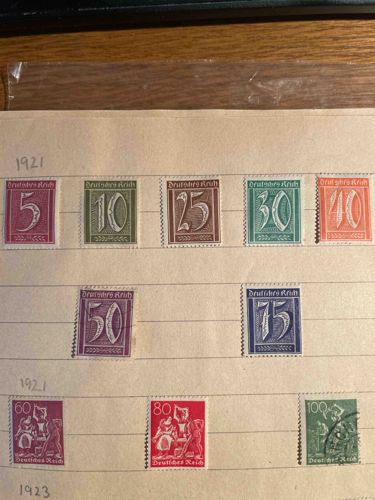
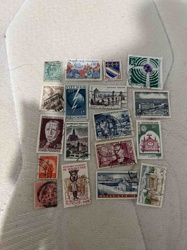
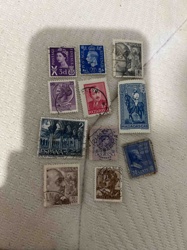
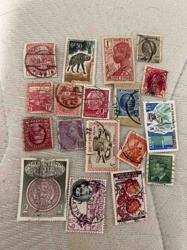
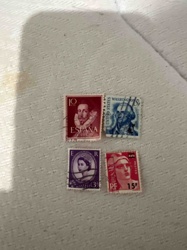
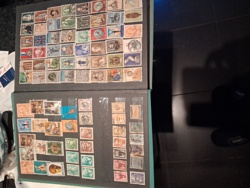
This item is a partial collection of postage stamps from the German Reich, primarily dating from 1921 to 1923, and presented on a light brown album page. The collection features two distinct series of stamps. The first series, dated '1921' to the left of the stamps, consists of several definitive stamps with large, ornate numerals indicating their face value. These stamps are rectangular with perforated edges and feature solid color backgrounds with the denomination and 'Deutsches Reich' (German Empire) printed. Observed denominations include 5 (reddish-purple), 10 (dark green), 25 (brownish-red), 30 (teal), 40 (orange-red), 50 (dark purple), and 75 (dark blue). The '50' pfennig stamp appears to have an overprint or watermark '5000-5000' or similar, indicating hyperinflation-era revaluations. The second series, dated '1923' below the stamps, includes pictorial stamps depicting figures engaged in labor or social activity, indicative of the 'Workers' or 'Inflation' issues. Denominations visible are 60 (dark red), 80 (bright red), and 100 (green, though largely obscured by a postmark or cancellation mark). Some stamps, particularly the 100-mark one, show signs of postal use with dark cancellation marks. The album page itself is simple, unlined, and appears to be made of sturdy, possibly acid-free, paper judging by its color and texture. The stamps are affixed to the page, likely using hinges or mounts, although the method is not explicitly clear for all. The overall condition of the stamps varies; some appear pristine, while others exhibit clear signs of postal use, such as cancellations. There are no obvious tears or major creases visible from the image, but slight discoloration or age toning may be present on both the stamps and the album page. The collection illustrates a period of significant economic upheaval in post-WWI Germany, particularly through the high denominations and the 'inflation issues' of 1923.
AI Appraisal Report
I have examined the provided image of this partial German Reich Postage Stamp Collection (1921-1923). The collection features two distinct series: the 1921 definitive stamps with large numerals (5 Pfg to 75 Pfg, plus a 50 Pfg with a '5000-5000' overprint) and the 1923 pictorial 'Workers' or 'Inflation' issues (60 Mk, 80 Mk, 100 Mk). Most stamps appear used with cancelations, which is typical for these issues. The condition seems generally good for used material, with no obvious major faults like tears or creases, though some postal wear and potential age toning are visible. The album page itself is simple and appears to be in good condition.
Authenticity is difficult to definitively confirm from an image alone. The designs appear consistent with genuine German Reich issues of the period. However, without a physical examination, I cannot rule out forgeries, reprints, or expertly repaired stamps. The '5000-5000' overprint, if genuine, is particularly interesting as it represents the hyperinflation era. Its authenticity would require close inspection under magnification.
Regarding market conditions, these German inflation-period stamps are relatively common. While historically significant, they were produced in vast quantities. Demand is steady among collectors of German philately, but rarity is generally low for most common denominations, especially in used condition. The overprinted stamp adds a modest premium if genuine. The overall collection, presented on a simple album page, is typical of what one might find in a starter collection or a general German accumulation.
Factors impacting value include the genuine nature of the overprint, the overall condition of individual stamps (freshness, clear cancels, lack of hidden faults), and the method of mounting (hinges can damage gum, though used stamps often lack original gum value). For a complete authentication, I would need to physically examine the stamps, check for watermarks, paper types, printing methods, and verify the authenticity of the overprint. Provenance documentation, if available, would also be beneficial.
Based on my visual assessment, assuming the stamps are genuine common varieties in typical used condition, I estimate the appraisal value for this partial collection to be in the range of $40-$70. This range accounts for the historical interest and the inclusion of the potentially more valuable overprinted stamp, provided it authenticates as genuine.