AI estimate as of October 3, 2025 · verify with a professional before acting
AI-Generated · Verify before acting
Everything on this page is generated by AI for informational purposes only. AI can make mistakes — the AI may misidentify items or misattribute them (artist, maker, brand, designer, origin, era). This is not an official valuation and should not be used for insurance, sale, tax, estate, legal, or lending purposes — or any decision requiring a certified appraisal. It is not an authoritative claim about any person, brand, or rights holder — do not share or rely on it as a factual statement about a third party. Always consult qualified professionals before making financial decisions.
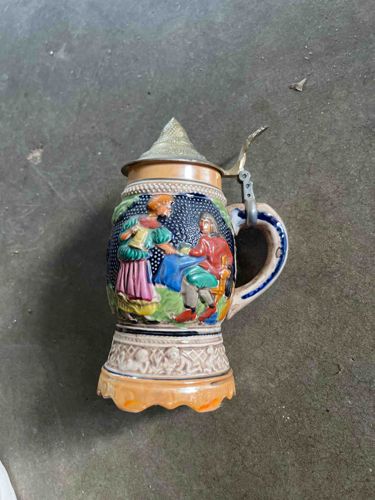
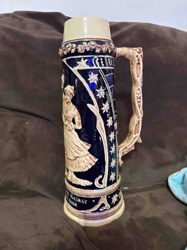
This is a vintage German character stein, likely crafted from ceramic or stoneware with a glazed finish and a pewter lid. The stein features a bulbous body with vibrant hand-painted, raised relief decorations. The main scene depicts two figures seated at a table-like surface against a dark blue stippled background. One figure, possibly female, wears a green top and pink skirt, while the other, likely male, is dressed in red and blue attire. The base of the stein boasts an ornate band of molded relief decoration, possibly depicting figures, animals, or heraldic motifs, in an off-white or light brown color, leading to a scalloped and ribbed lower rim in an earthy orange hue. The handle, which appears to be part of the ceramic body, has a subtle blue striped pattern near its attachment point to the rim. A hinged pewter lid, conical in shape with a textured, possibly hammered or cast, surface, crowns the stein. The lid is attached via a sturdy pewter thumb-lever mechanism. Visible condition issues include some wear and chipping on the orange base rim, and potential discoloration or patination on the metal lid, consistent with age and use. The overall craftsmanship suggests a mass-produced item from the mid-20th century, common for tourist or souvenir markets, but with a certain level of detail in the hand-painting and molding that indicates reasonable quality for its type. No specific maker's marks or signatures are discernible from the provided images, but the style is characteristic of traditional German steins.
AI Appraisal Report
Based on my visual examination of the provided image, this vintage German character stein appears to be a mass-produced item, likely from the mid-20th century. The ceramic or stoneware body features vibrant hand-painted, raised relief decorations. The two figures at the table, along with the ornate base band and scalloped rim, suggest a decorative tourist or souvenir piece characteristic of the period. Authenticity, based solely on visual cues, points to it being a genuine utilitarian decorative stein, rather than a high-art collectible. I note wear and chipping on the orange base rim and potential patination on the pewter lid, consistent with age and use, which slightly diminishes its overall aesthetic appeal, but not its fundamental character as a vintage piece.
Market conditions for such character steins are moderate. While there is a consistent collector base, this particular style and apparent craftsmanship place it in the mid-range of desirability. Comparables frequently surface in online auctions and antique shops, typically selling in the $50-$120 range depending on condition and specific decorative motifs. While charming, its design is not exceptionally rare, nor does it present unique artistic merit that would drive significantly higher demand or value. The lack of discernible maker's marks or signatures prevents attribution to a specific, highly coveted manufacturer, which would otherwise boost its value. Factors impacting value include its good, albeit imperfect, condition, the hand-painted detailing, and the pewter lid.
For a full authentication and more precise valuation, a physical in-person examination would be crucial to assess the true extent of wear, confirm materials, and search for obscured marks. Further, provenance documentation, if available, could confirm age and origin more definitively. Scientific testing of materials would only be necessary to address specific concerns about authenticity, which are not apparent from the images.