AI estimate as of December 13, 2025 · verify with a professional before acting
AI-Generated · Verify before acting
Everything on this page is generated by AI for informational purposes only. AI can make mistakes — the AI may misidentify items or misattribute them (artist, maker, brand, designer, origin, era). This is not an official valuation and should not be used for insurance, sale, tax, estate, legal, or lending purposes — or any decision requiring a certified appraisal. It is not an authoritative claim about any person, brand, or rights holder — do not share or rely on it as a factual statement about a third party. Always consult qualified professionals before making financial decisions.
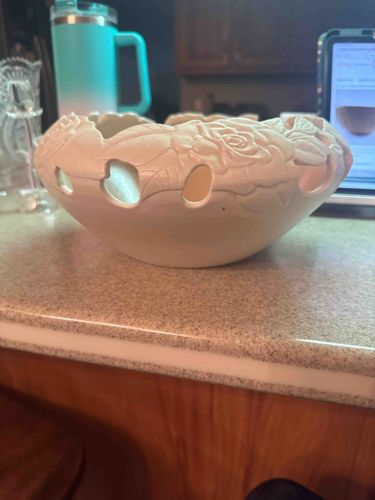
This appears to be a ceramic bowl with a light, off-white or cream color, featuring an intricate relief design of roses and foliage along its upper exterior rim. The bowl has a gentle, undulating rim that follows the contours of the rose pattern, giving it a somewhat organic and flowing aesthetic. Several irregularly shaped perforations or cut-outs are present around the body of the bowl, allowing light to pass through. These perforations are smooth-edged, suggesting they were intentionally designed as part of the decorative element rather than damage. The interior of the bowl seems to be smooth and undecorated, corresponding to the exterior's light color. The material appears to be unglazed ceramic, possibly bisque ware, or a matte-glazed finish, which contributes to its soft, earthy aesthetic. There are no visible maker's marks or signatures discernible from the image. The style suggests a decorative piece, possibly from the mid-20th century to contemporary, reflecting a classic floral motif often seen in home decor. The craftsmanship appears to be of decent quality, with clear details on the rose petals and leaves. No significant visible condition issues such as cracks, chips, or repairs are apparent, though the unglazed surface might be prone to staining or dust accumulation over time. The item serves primarily as a decorative accent piece, potentially for potpourri or simply as an ornamental bowl.
AI Appraisal Report
Based on my visual examination of the provided image, this Perforated Ceramic Rose Bowl appears to be in very good condition with no visible chips, cracks, or repairs. The intricate relief of roses and foliage, coupled with the intentional perforations, suggests a decorative piece of decent craftsmanship. The unglazed or matte-glazed finish contributes to a soft, earthy aesthetic, likely from the mid-20th century to contemporary production, echoing a classic floral motif. Its light, off-white/cream color adds to its versatile appeal in various home décor settings.
Market conditions for such decorative ceramic bowls are generally moderate. While attractive, items of this nature without definitive artist attribution, significant age, or provenance tend to fall into a lower to mid-range market segment. Comparable items, including unglazed or bisque ceramic decorative bowls with floral motifs found in antiques malls, online marketplaces, and estate sales, typically retail in the $30-$100 range depending on size, intricacy, and brand recognition. This piece, lacking any discernible maker's marks or signatures, would be valued toward the lower end of that spectrum.
Factors impacting value include its decorative appeal and good condition. The lack of a known maker or unique historical significance prevents it from commanding higher prices. Demand for general decorative ceramic items remains steady but is not robust for unmarked pieces. Rarity is low; similar styles are commonly found.
It is crucial to note that my assessment of authenticity and condition is based solely on a two-dimensional image. Without a physical in-person examination, I cannot conclusively verify the material composition (e.g., true bisque vs. matte glazed porcelain), detect hairline cracks, minor repairs, or subtle discoloration not visible in the photograph. Furthermore, definitive authenticity regarding a specific manufacturer or artist, if any, often requires an in-person inspection for maker's marks, as well as potential provenance documentation or scientific testing to determine exact age and origin. For this particular item, given its likely market segment, extensive scientific testing would not be cost-effective or necessary.