AI estimate as of July 7, 2025 · verify with a professional before acting
AI-Generated · Verify before acting
Everything on this page is generated by AI for informational purposes only. AI can make mistakes — the AI may misidentify items or misattribute them (artist, maker, brand, designer, origin, era). This is not an official valuation and should not be used for insurance, sale, tax, estate, legal, or lending purposes — or any decision requiring a certified appraisal. It is not an authoritative claim about any person, brand, or rights holder — do not share or rely on it as a factual statement about a third party. Always consult qualified professionals before making financial decisions.
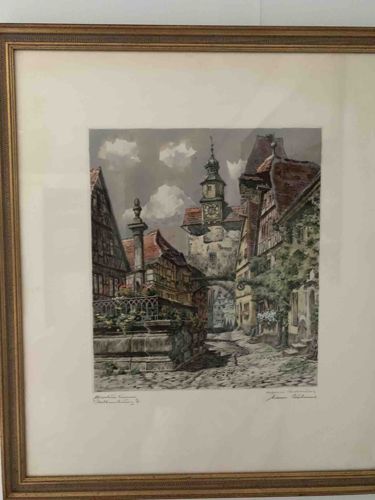
This item is a framed art print, likely a colored etching or an aquatint, depicting a charming European street scene, possibly German or Austrian, given the architectural style. The print showcases a detailed urban landscape with half-timbered buildings, some with red-tiled roofs, creating a sense of historical charm. A prominent feature is a tiered clock tower in the background, adding depth and architectural interest to the composition. In the foreground, there's a stone fountain or well structure with decorative ironwork, adorned with potted plants or flowers, suggesting a vibrant and lively atmosphere. The cobblestone street recedes into the distance, with an archway visible, hinting at further passages. The color palette is muted but effective, featuring earthy tones of brown, terracotta, and grey, accented with greens from foliage and a pale blue/grey for the sky with prominent clouds. The print is housed under glass within a gold-colored, possibly wooden, frame with an ornate, reeded or carved design. A wide, off-white or cream-colored mat surrounds the artwork, providing a visual border and separation from the frame. The visibility of the print's details, including potential artist's signature or title in the lower margins, is somewhat obscured by glare and resolution, but there appears to be text in pencil or graphite, which may indicate a limited edition number or artist's signature. The overall condition appears good, with no obvious signs of damage to the print itself or the frame, though minor wear consistent with age might be present upon closer inspection. The framing suggests a classic or traditional aesthetic, likely from the mid-20th century or earlier.
AI Appraisal Report
Based on my visual examination of the provided image, this framed art print, likely a colored etching or aquatint depicting a European street scene, appears to be in good overall condition. The print itself shows no obvious signs of tearing, creasing, or significant foxing, though minor discoloration consistent with age cannot be entirely ruled out without physical inspection. The frame, a gold-colored ornate design, also appears sound, with no visible major chips or cracks, although slight nicks or wear common with age are probable.
Authenticity is difficult to definitively confirm from images alone. While there appears to be text in the lower margin that could indicate a limited edition number or artist's signature, high-resolution close-ups or in-person examination are crucial to verify this. The style suggests it could be from the mid-20th century or earlier.
In terms of market conditions, European street scene prints, especially those with a charming or nostalgic appeal, generally have a steady but not exceptionally high demand. Comparables for unsigned or unattributed prints of this type typically fall into the 'decorative art' category. Signed, numbered, or artist-attributed pieces fetch higher prices. Rarity is difficult to ascertain without knowing the artist and edition size; many such prints were produced in relatively large editions.
Factors significantly impacting value include the identification of the artist, whether it's a limited edition print (and its number), and the specific printmaking technique. A well-known artist or a rare, early impression would drastically increase value. Conversely, a mass-produced decorative print would place it at the lower end.
Limitations in authenticity verification are significant here. For full authentication and accurate valuation, an in-person examination is essential to assess the print's surface for damage, examine the paper quality, verify the printmaking technique, and, most importantly, clearly identify any signatures, titles, or numbering. Provenance documentation (e.g., original purchase receipts, gallery labels) would also be invaluable. Scientific testing, such as pigment analysis or paper dating, could confirm the age but would be a costly undertaking typically reserved for higher-value art.