AI estimate as of July 24, 2025 · verify with a professional before acting
AI-Generated · Verify before acting
Everything on this page is generated by AI for informational purposes only. AI can make mistakes — the AI may misidentify items or misattribute them (artist, maker, brand, designer, origin, era). This is not an official valuation and should not be used for insurance, sale, tax, estate, legal, or lending purposes — or any decision requiring a certified appraisal. It is not an authoritative claim about any person, brand, or rights holder — do not share or rely on it as a factual statement about a third party. Always consult qualified professionals before making financial decisions.
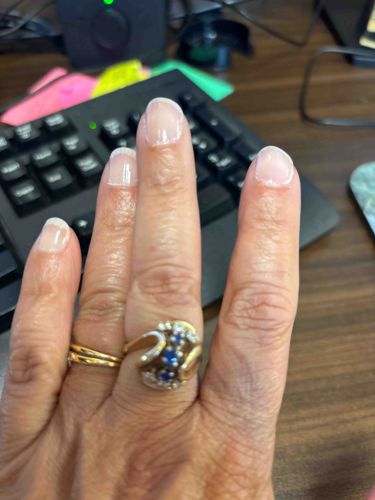
The item in question is a gold-toned ring, likely crafted from yellow gold, which features a prominent cluster of gemstones. The ring displays a stylized, possibly abstract or naturalistic design on its top, with curved and flowing gold elements that frame and integrate the gemstones. At the center of the cluster are three oval or pear-shaped deep blue gemstones, most likely sapphires, set vertically in a line. Surrounding these blue stones are multiple smaller, round, clear gemstones, which appear to be diamonds or diamond simulants, set in a pave or bead setting, creating a halo or accentuating border. There are also two larger, round clear gemstones flanking the central blue stones, one on each side, further contributing to the cluster design. The ring's band appears to be relatively broad at the shoulders, tapering slightly towards the back. The metal exhibits a moderate polish, showing some signs of wear consistent with regular use, such as minor surface scratches and possibly some slight darkening in crevices, indicating a natural patina. The setting of the stones seems secure, though a closer inspection would be required to assess the integrity of each prong or bead. The overall style suggests a mid-20th century to late 20th century design aesthetic, possibly a cocktail ring given its elaborate top. The craftsmanship appears to be good, with all stones present and no immediately visible damage to the metal structure. The specific karat weight of the gold or the precise carat weight and clarity of the stones cannot be determined from the image alone, but the visible quality of the setting and the luster of the stones indicate a well-made piece.
AI Appraisal Report
Upon visual examination of this Gold-Toned Gemstone Cluster Ring, I observe a well-crafted piece, likely yellow gold, featuring a prominent cluster design. The presence of three oval or pear-shaped deep blue gemstones, strongly suggestive of sapphires, centralized and flanked by numerous smaller, clear stones, which appear to be diamonds, indicates a significant jewelry item. The setting style, possibly pave or bead, for the smaller clear stones, along with two larger clear stones, contributes to an elaborate aesthetic often characteristic of cocktail rings. The metal shows a moderate polish with some surface scratches and slight darkening in crevices, consistent with regular wear and a natural patina for an item potentially dating from the mid to late 20th century. All visible stones appear secure.
Given current market conditions, demand for vintage gemstone cluster rings, especially those incorporating sapphires and diamonds, remains stable. Comparables would include similar gold rings with natural sapphires and diamond accents, with value largely influenced by the quality and carat weight of the gemstones, and the gold purity. While the sapphires appear to be of good color, and the diamonds show reasonable sparkle, accurate assessment of their clarity, cut, and carat weight is impossible from an image alone. The specific karat weight of the gold also cannot be determined visually.
Factors significantly impacting value include the actual grade of the sapphires (natural vs. treated), whether the clear stones are indeed natural diamonds or simulants, and the purity of the gold. Limitations inherent in appraising from an image mean I cannot verify authenticity of materials (e.g., natural vs. synthetic stones, specific metal composition) or accurately assess total carat weights. For full authentication and a precise valuation, an in-person examination is crucial. This would involve specific gravity tests for gemstones, spectroscopic analysis for stone identification, precise measurement of stones for carat weight estimation, and gold purity testing (e.g., acid test or XRF). Provenance documentation would also add significant value.