AI Appraisal Estimate

AI-generated estimates · not official valuations

From the user

What was submitted

Photo and notes provided by the user — not generated by AI

Submitted item photo
Submitted photo · June 12, 2026

User's notes

No additional notes provided.

AI analysis below

AI appraisal

AI analysis & estimate

AI-Generated · Verify before acting

Everything below is generated by AI for informational purposes only. AI can make mistakes — the AI may misidentify items or misattribute them (artist, maker, brand, designer, origin, era). This is not an official valuation and should not be used for insurance, sale, tax, estate, legal, or lending purposes — or any decision requiring a certified appraisal. It is not an authoritative claim about any person, brand, or rights holder — do not share or rely on it as a factual statement about a third party. Always consult qualified professionals before making financial decisions.

Read the full disclaimer

AI Identification

·Not independently authenticated·Verify before acting

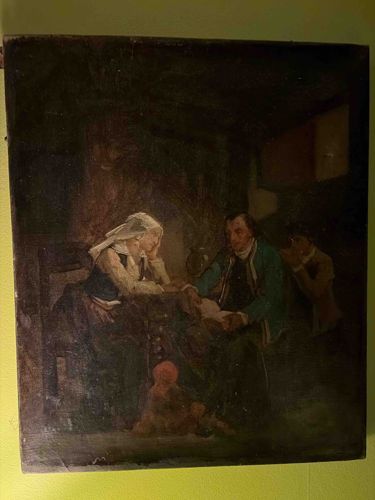
19th Century European Genre Scene Oil Painting

Fine Art - Paintings

AI Estimated Value

·Not an official valuation·Verify before acting

$1,200 - $1,800

As of June 12, 2026

AI Item Analysis

·AI can make mistakes·Verify before acting
This item is an original oil painting on canvas, likely dating from the mid-to-late 19th century. The work is a classic genre scene depicting a domestic interior with three figures. A central female figure wearing a white headscarf is seated at a table, looking down in a contemplative or mournful pose. She is joined by a man in a blue coat holding a document, and a third figure in the background. The composition employs a chiaroscuro effect, with a strong light source highlighting the woman's head and the document, while the rest of the room remains in deep, atmospheric shadow. The color palette is dominated by earthy browns, deep greens, and ochres, typical of the academic realism style of the period. Regarding condition, the painting shows significant 'alligator' cracking (craquelure) throughout the surface, particularly in the darker pigments, suggesting age and environmental exposure. There is visible surface grime and yellowed varnish, which obscures some of the finer detail. Minor paint loss is evident along the edges where the canvas meets the frame (currently unframed). No signature or maker's mark is immediately visible on the front, though one may be hidden under the grime or located on the reverse. The brushwork appears deliberate and skilled, showing high-quality craftsmanship in the rendering of fabric folds and facial expressions.

AI Appraisal Report

·AI can make mistakes·Verify before acting
Based on my visual analysis of this 19th-century European genre scene, the work displays high technical skill consistent with mid-to-late 19th-century academic realism. The mastery of chiaroscuro and the emotional depth in the figures' poses suggest a professional, albeit currently anonymous, hand. The subject matter—a domestic interior—was highly marketable in the 19th century and remains sought after by collectors of period decor and traditional realism. The condition significantly impacts the current valuation. The 'alligator' craquelure suggests the painting has undergone substantial movement between the substrate and paint layers, likely due to fluctuating humidity. The yellowed varnish and surface grime obscure the original luminosity of the palette. While the craftsmanship is evident in the rendering of the fabric and melancholic expressions, the lack of a visible signature limits the value to that of an 'attributed' or 'school of' work rather than a known master. Compared to similar unattributed European genre scenes sold at regional auctions, this piece holds strong decorative value. However, the costs of professional cleaning and stabilization (conserving the craquelure) would likely range from $500 to $900, which is factored into the current estimate. Limitations: This appraisal is based solely on digital imagery. Full authentication is impossible without a physical inspection to verify the canvas weave, stretcher bar construction, and possible signatures on the reverse. Scientific testing, such as UV fluorescence or infrared reflectography, would be required to identify overpainting or hidden marks. A definitive provenance or discovery of a signature during cleaning could increase the value significantly, potentially exceeding $5,000.

Get your items appraised

Instant estimates of your treasures with AI-powered appraisals

Browse More Appraisals