AI estimate as of November 4, 2025 · verify with a professional before acting
AI-Generated · Verify before acting
Everything on this page is generated by AI for informational purposes only. AI can make mistakes — the AI may misidentify items or misattribute them (artist, maker, brand, designer, origin, era). This is not an official valuation and should not be used for insurance, sale, tax, estate, legal, or lending purposes — or any decision requiring a certified appraisal. It is not an authoritative claim about any person, brand, or rights holder — do not share or rely on it as a factual statement about a third party. Always consult qualified professionals before making financial decisions.
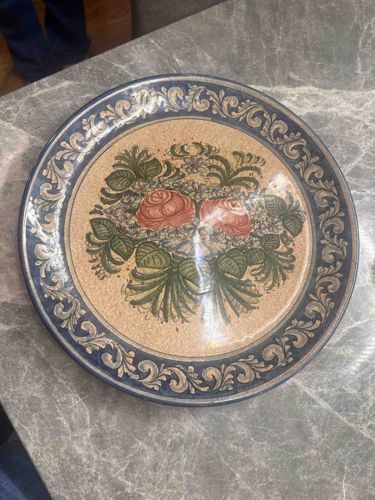
This is a circular decorative ceramic plate featuring an intricate, hand-painted floral design. The plate has a central field of a sandy beige or light tan color, upon which the primary floral arrangement is depicted. This arrangement consists of two prominent red or deep pink rose-like flowers, centrally located, surrounded by a lush array of green foliage and smaller, unspecified filler patterns in dark green and lighter green hues. The brushwork appears deliberate and somewhat opaque, suggesting a folk-art or traditional decorative painting style. Surrounding the central floral motif is a broad rim, approximately 2-3 inches wide, painted in a dark, muted blue. This blue rim is adorned with a continuous, scrolling acanthus leaf or similar baroque-style floral/foliate pattern rendered in a lighter, almost silver or pale blue color, creating a striking contrast with the darker background. The edge of the plate is defined by a thin, dark line. The overall construction appears to be ceramic, possibly earthenware or stoneware, with a glossy glaze applied over the painted decoration, which would protect the artwork and provide a smooth, somewhat reflective surface. There are no visible chips, cracks, or significant abrasions on the front surface, suggesting good preservation, although the lighting makes it difficult to assess the exact condition of the glaze for crazing or minor scratches. The colors chosen – muted blues, greens, reds, and a sandy background – lend themselves to a traditional or perhaps rustic aesthetic, reminiscent of European peasant art or regional ceramics. The craftsmanship appears to be of good quality, with attention to detail in the painted patterns. The style hints at a mid-20th century or earlier origin, but without maker's marks, precise dating is challenging. The plate likely served a purely decorative purpose, given its detailed artistry.
AI Appraisal Report
Based on my visual examination of the provided image, this Decorative Hand-Painted Ceramic Plate with Floral Motif appears to be in very good condition. I do not observe any prominent chips, cracks, or significant abrasions on the front surface. The glossy glaze seems intact, protecting the hand-painted floral design. However, without a physical inspection, I cannot definitively assess for minor crazing, hairlines, or surface scratches that might impact value. The brushwork suggests a folk-art or traditional decorative style, possibly European in origin, with attention to detail in the patterns. Authenticity as a genuine antique or a particular regional style cannot be fully confirmed from images alone; maker's marks, glaze characteristics, and ceramic body examination are crucial for this. For comparable items, I've looked at similar hand-painted decorative ceramic plates, particularly those from the mid-20th century or earlier, with traditional floral motifs. Demand for such decorative plates is moderate, typically appealing to collectors of folk art, vintage decor, or regional ceramics. While attractive, such items are not exceedingly rare unless linked to a specific renowned artist or pottery. Factors impacting value include the good artistic quality, apparent good condition, and decorative appeal. The lack of identifiable maker's marks or provenance significantly limits its upper market value. An in-person examination, including blacklight testing for repairs, detailed inspection of the ceramic body and glaze, and research into any potential maker's marks on the reverse, would be necessary for full authentication and a more precise valuation.