AI estimate as of August 31, 2025 · verify with a professional before acting
AI-Generated · Verify before acting
Everything on this page is generated by AI for informational purposes only. AI can make mistakes — the AI may misidentify items or misattribute them (artist, maker, brand, designer, origin, era). This is not an official valuation and should not be used for insurance, sale, tax, estate, legal, or lending purposes — or any decision requiring a certified appraisal. It is not an authoritative claim about any person, brand, or rights holder — do not share or rely on it as a factual statement about a third party. Always consult qualified professionals before making financial decisions.
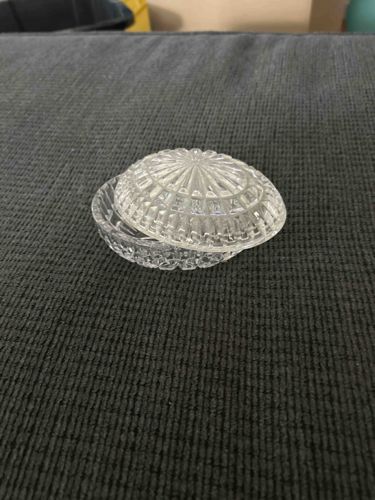
This item is a clear pressed glass trinket box or covered dish, likely intended for small items such as candies, butter, or jewelry. It consists of two main pieces: a shallow base and a domed lid. Both components are made of transparent, colorless glass, exhibiting a brilliant quality that reflects light. The lid is the most prominent feature, displaying a complex, radial pattern of raised geometric facets, resembling a starburst or fan design from the center, transitioning to a grid or waffle-like pattern around its circumference. The edges appear scalloped or fluted, adding to its decorative appeal. The base, though less visible, seems to have a coordinating pattern around its rim, suggesting a consistent design aesthetic. The construction indicates machine-pressed glass, common from the late 19th century through the mid-20th century. There are no immediately apparent signs of significant damage like chips, cracks, or repairs, suggesting it is in good, used condition. The clarity of the glass and the precision of the pressed patterns indicate a good level of craftsmanship for mass-produced glassware of its era. This piece likely dates from the Art Deco period or slightly later, possibly mid-20th century, given the geometric and somewhat ornate design work. Its function is primarily decorative, but also practical for storage.
AI Appraisal Report
Based on my visual examination of the provided image, this clear pressed glass trinket box/covered dish appears to be in good, used condition with no immediately apparent chips, cracks, or significant damage. The brilliance of the glass and the clarity of the pressed patterns suggest good craftsmanship for its type. The design, featuring a complex radial pattern on the domed lid and a coordinating pattern on the base, is characteristic of mass-produced pressed glass from the late 19th to mid-20th century, with the geometric elements hinting at a possible Art Deco or mid-century influence.
This piece's authenticity as a genuine pressed glass item is strongly supported by its visual characteristics, typical of common manufacturing processes for such items. Its function as a decorative yet practical storage item, often for candies, butter, or jewelry, means it falls into a broad category of collectible household glass.
In terms of market conditions, items of this nature are widely available. While charming, pressed glass trinkets are not particularly rare, and demand for common patterns tends to be moderate. Comparables in the current market, whether online or at antique malls, typically fall within a modest price range, reflecting their abundance and decorative rather than high-value collectible status.
Factors impacting value include the condition (which appears good), the aesthetic appeal of the geometric pattern, and the general availability of similar items. While desirable for decoration or practical use, it does not possess the rarity or provenance typically associated with higher appraisal values.
It is crucial to note the limitations of appraising from images alone. A definitive authentication and assessment of condition, including minute flakes, internal stress cracks, or repairs not visible in photographs, would require a direct, in-person examination. Furthermore, provenance documentation would be needed to trace its history, though for common pressed glass, this is rarely available or necessary for valuation purposes. Scientific testing is generally not applied to items of this nature.