AI estimate as of July 6, 2025 · verify with a professional before acting
AI-Generated · Verify before acting
Everything on this page is generated by AI for informational purposes only. AI can make mistakes — the AI may misidentify items or misattribute them (artist, maker, brand, designer, origin, era). This is not an official valuation and should not be used for insurance, sale, tax, estate, legal, or lending purposes — or any decision requiring a certified appraisal. It is not an authoritative claim about any person, brand, or rights holder — do not share or rely on it as a factual statement about a third party. Always consult qualified professionals before making financial decisions.
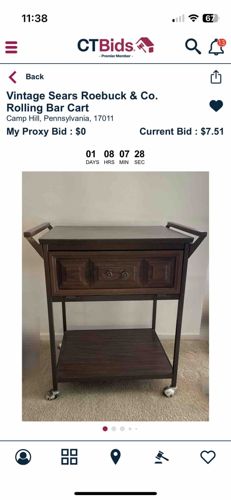
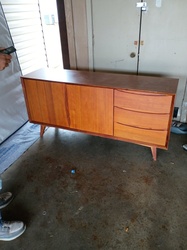
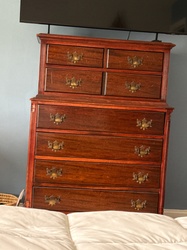
This is a vintage Sears Roebuck & Co. rolling bar cart. The cart features a dark wood finish, likely a stained hardwood, judging by the grain visible in certain areas. It has a rectangular top surface, providing a dedicated area for mixing drinks or displaying items. Below the top, there is a central cabinet section with a drawer, adorned with decorative molding and what appears to be a single, ornate, metal pull handle, possibly brass or an antiqued gold-toned metal. The drawer front is characterized by raised paneled accents, suggesting a more traditional or classic design aesthetic. Extending from either side of the top surface are two folding or drop-leaf extensions, indicated by the 'wings' that are currently folded down, which would expand the usable surface area when raised. The cart is supported by four slender, square-profile metal legs, providing a sturdy base. Towards the bottom, there is a secondary shelf, matching the dark wood finish of the upper components, offering additional storage or display space. The entire unit is mobile, resting on four small, dual-wheel casters, likely made of plastic or hard rubber, indicating its functionality as a rolling bar or serving cart. The overall condition appears to be good for a vintage piece, showing a consistent patina across the wooden surfaces, with no immediately visible major damage, deep scratches, or repairs, though closer inspection would be required to identify minor wear consistent with age and use. The craftsmanship appears solid, typical of mass-produced, yet functional, furniture from the mid-20th century. The style suggests a mid-century or slightly earlier period, consistent with the 'vintage Sears Roebuck & Co.' designation.
AI Appraisal Report
Upon examining the provided images of this vintage Sears Roebuck & Co. rolling bar cart, I assess its value based on its visual characteristics and current market conditions for similar items. The cart appears to be in good vintage condition, exhibiting a consistent patina and no major signs of damage, such as deep scratches or significant veneer loss. The dark wood finish, drop-leaf extensions, central drawer with ornate hardware, and metal legs on casters are all characteristic of mid-20th-century mass-produced furniture. Sears Roebuck pieces were known for their functional, accessible design rather than high-end craftsmanship, which places them in a more modest price bracket.
Current market comparables for non-designer, mid-century rolling bar carts typically fall within the $100 to $300 range, depending on condition, style, and sales platform. The demand for functional and stylish bar carts remains steady, but this specific model does not possess the rarity or designer association that would command a higher price. The primary value drivers here are its functionality and retro aesthetic.
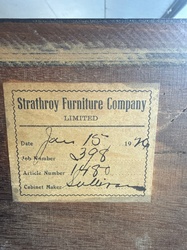
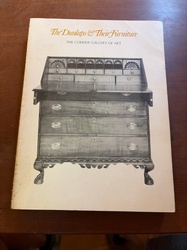
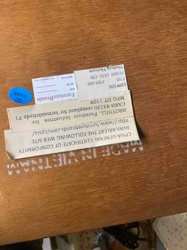
It is important to note the limitations of an appraisal based solely on images. An in-person examination is necessary to confirm the structural integrity, the smooth operation of the casters and drawer, and to identify any subtle repairs or surface damage not visible in photos. Confirming the authenticity of the hardware and the originality of the finish would also require physical inspection. Without maker's marks, provenance documentation, or catalog references, attributing it definitively to a specific Sears Roebuck & Co. line is challenging.