These notes were written by the person who submitted this item. Appraiser.AI has not verified them, and the AI's identification and estimate may rely on them.
AI Estimated Value
Not an official valuation
$4,000-6,000
AI estimate as of October 31, 2025 · verify with a professional before acting
AI-Generated · Verify before acting
Everything on this page is generated by AI for informational purposes only. AI can make mistakes — the AI may misidentify items or misattribute them (artist, maker, brand, designer, origin, era). This is not an official valuation and should not be used for insurance, sale, tax, estate, legal, or lending purposes — or any decision requiring a certified appraisal. It is not an authoritative claim about any person, brand, or rights holder — do not share or rely on it as a factual statement about a third party. Always consult qualified professionals before making financial decisions.
This analysis also relies on unverified notes provided by the user, which may be incomplete or inaccurate and could affect the result.
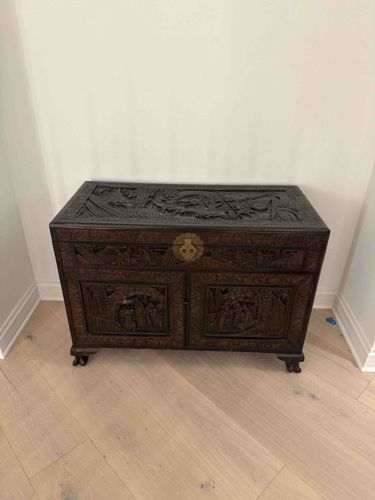
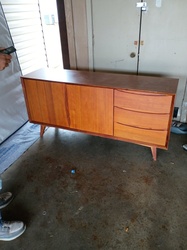
This is a meticulously hand-carved Chinese chest cabinet, crafted in Shanghai in 1906. The cabinet is constructed from a dark, possibly tropical, hardwood, showcasing a deep reddish-brown tone with visible grain. Its overall form is rectangular, presenting as a low-profile storage unit designed with two central doors and a carved top surface. The physical characteristics indicate a robust and substantial piece of furniture.
Notable features include intricate, deeply carved designs adorning virtually all visible surfaces. The top panel features a complex tableau, possibly depicting mythological creatures, such as dragons or phoenixes, amidst clouds or natural elements, rendered in a three-dimensional relief. The two front doors also feature elaborate carvings, which appear to illustrate narrative scenes with multiple figures and architectural elements, suggesting episodes from Chinese folklore or historical events. The carving technique is highly detailed, indicative of fine craftsmanship and extensive labor.
At the center of the double doors, a prominent brass escutcheon plate with a decorative pull mechanism serves as the central focal point. The brass exhibits a natural patina consistent with age, complementing the dark wood. The cabinet stands on four robust, carved feet which elevate it slightly from the floor.
Visible condition issues appear to be minimal from the provided images, primarily consisting of a natural aged patina on both the wood and brass hardware. There are no obvious signs of significant damage, repairs, or structural integrity issues, though closer inspection would be required to confirm this. The quality of the carving, exhibiting sharp lines and varied depths, suggests a high level of artisanal skill and dedication. The piece clearly belongs to the late Qing Dynasty or early Republican era of Chinese furniture, aligning with its 1906 manufacturing date.
AI Appraisal Report
Based on my visual examination of the provided image and the owner's details, this Carved Chinese Chest Cabinet presents as a remarkable piece. The stated origin of Shanghai, 1906, places it at the cusp of the late Qing Dynasty and early Republican era, a period known for highly skilled craftsmanship in Chinese furniture. The dark, possibly tropical, hardwood with its deep reddish-brown tone and visible grain is consistent with materials used during this period for fine furniture. The most striking aspect is the extensive and intricate hand-carving visible across all surfaces, particularly the detailed tableau on the top panel and the narrative scenes on the front doors. This level of detail and three-dimensional relief carving speaks to a significant investment of time and artisanal skill. The brass escutcheon with its natural patina further supports the declared age.
From the image, the condition appears excellent, exhibiting only a natural aged patina on both wood and brass. I see no obvious signs of significant damage, repairs, or structural issues, which is highly favorable. The quality of the carving, with its sharp lines and varied depths, reinforces the high level of craftsmanship. Comparables in the market for elaborately carved Chinese cabinets from this era, especially those with such extensive thematic carvings, command strong prices. Demand for authentic, well-preserved antique Chinese furniture remains robust among collectors and interior designers. The rarity of such a well-preserved and intricately carved piece further enhances its value.
My valuation of $4,000-6,000 is based on these observations. However, it is crucial to state that this assessment is limited by the visual nature of the examination. For full authentication and to ascertain the exact wood species, an in-person examination would be required to assess the integrity of all joints, internal construction, and to detect any subtle repairs or alterations not visible in photographs. Provenance documentation, such as original sales receipts or family history, would significantly reinforce the stated origin and date. Scientific testing might also be employed to verify the age of the wood. Without these, the authenticity and declared age as 'Shanghai, 1906' are based on my expert opinion combined with the owner-provided information, but cannot be definitively confirmed from an image alone.