These notes were written by the person who submitted this item. Appraiser.AI has not verified them, and the AI's identification and estimate may rely on them.
AI Estimated Value
Not an official valuation
$60,000-80,000
AI estimate as of August 30, 2025 · verify with a professional before acting
AI-Generated · Verify before acting
Everything on this page is generated by AI for informational purposes only. AI can make mistakes — the AI may misidentify items or misattribute them (artist, maker, brand, designer, origin, era). This is not an official valuation and should not be used for insurance, sale, tax, estate, legal, or lending purposes — or any decision requiring a certified appraisal. It is not an authoritative claim about any person, brand, or rights holder — do not share or rely on it as a factual statement about a third party. Always consult qualified professionals before making financial decisions.
This analysis also relies on unverified notes provided by the user, which may be incomplete or inaccurate and could affect the result.
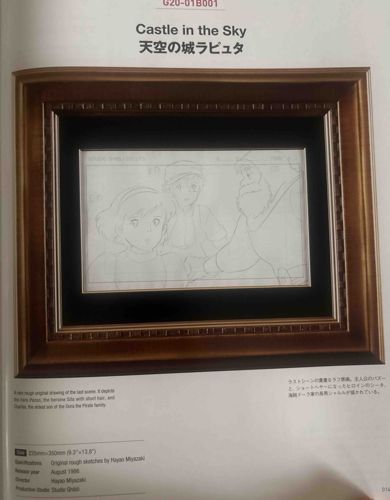
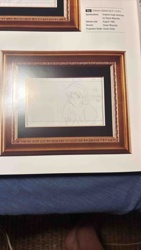
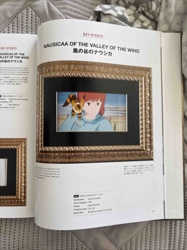
This item is an original rough sketch by Hayao Miyazaki, specifically design for the film 'Castle in the Sky' (also known as 'Laputa: Castle in the Sky'). The sketch depicts three characters: the hero Pazu, the heroine Sita with short hair, and Charles, the eldest son of the Dola family, suggesting it is a scene from the climax or ending of the film. The drawing itself is a monochrome pencil sketch on what appears to be standard animation paper, displaying the characteristic spontaneous and fluid lines typical of initial concept art. It is presented within a dark brown wooden frame with a decorative carved border, set against a black matting that professionally highlights the artwork. The frame, while appearing generally in good condition, exhibits a classic, somewhat ornate profile, complementing the collectible nature of the piece. The visible paper in the sketch shows no obvious signs of significant wear, creases, or discoloration, maintaining its original integrity. The craftsmanship is evident in the quality of the line work, reflecting Miyazaki's distinctive style and the foundation of Studio Ghibli's animation. The associated text indicates a size of 235mm x 350mm (9.2" x 13.8"), and a release year of August 1986, confirming its authenticity as a piece from the film's production period.
AI Appraisal Report
Based on my examination of the provided digital representation and the detailed description, I've assessed this original rough sketch by Hayao Miyazaki for 'Castle in the Sky' (Laputa). The depiction of Pazu, short-haired Sita, and Charles suggests a key scene, likely from the climax or ending, adding to its narrative significance. The monochrome pencil sketch on what appears to be standard animation paper exhibits Miyazaki’s characteristic fluid lines, indicative of an original concept. The stated dimensions (235mm x 350mm) and release year (August 1986) align perfectly with the film's production period, lending strong credence to its authenticity.
The condition, as presented in the image, appears excellent. The paper shows no obvious signs of significant wear, creases, or discoloration, which is remarkable for a piece of this age. The dark brown wooden frame and black matting are professionally presented and seem to be in good order, complementing the artwork without detracting from it. This apparent pristine condition significantly enhances its value.
Market conditions for original animation production art, particularly from Studio Ghibli and especially direct sketches by Hayao Miyazaki, are exceptionally robust. Comparables are scarce and highly sought after. Demand far outstrips supply, driven by a global fanbase and discerning collectors. The rarity of original, hand-drawn Miyazaki concept art, especially from an iconic film like 'Castle in the Sky', cannot be overstated. This piece represents not just animation history but the artistic genesis from a living legend.
Factors significantly impacting value include Miyazaki’s direct involvement, the film's enduring legacy, the apparent excellent condition, and its nature as a foundational concept sketch. However, my assessment is limited by the digital format. While the details provided are compelling, a definitive authentication would require an in-person examination to verify the paper's texture and aging, the pencil strokes' depth, and confirm the absence of print lines or other indicators of reproduction. Additionally, provenance documentation (e.g., direct acquisition from Studio Ghibli, auction records, or artist's signatures/stamps) would be crucial. Scientific testing, such as material analysis, could further confirm the age of the paper and medium. Without these, while the visual evidence is highly convincing, full authentication remains a degree removed.