AI estimate as of September 30, 2025 · verify with a professional before acting
AI-Generated · Verify before acting
Everything on this page is generated by AI for informational purposes only. AI can make mistakes — the AI may misidentify items or misattribute them (artist, maker, brand, designer, origin, era). This is not an official valuation and should not be used for insurance, sale, tax, estate, legal, or lending purposes — or any decision requiring a certified appraisal. It is not an authoritative claim about any person, brand, or rights holder — do not share or rely on it as a factual statement about a third party. Always consult qualified professionals before making financial decisions.
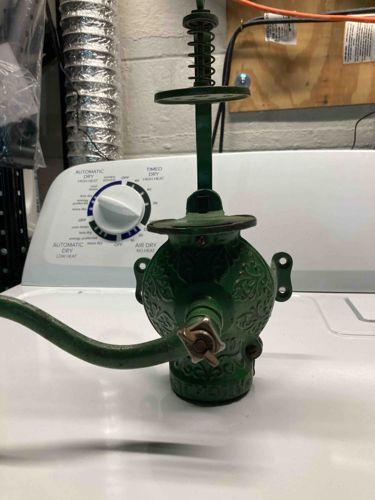
This appears to be a vintage cast iron hand-crank coffee grinder, distinguished by its vibrant dark green painted finish. The body of the grinder is robustly constructed from cast iron, featuring an ornate, embossed scrollwork or floral pattern on both sides, indicative of its older manufacturing style. The design suggests a decorative as well as functional item, likely from the early to mid-20th century. A substantial handle, also green-painted cast iron, extends curvilinearly from the main body, ending in what would typically be a wooden or metal knob (not fully visible here beyond the mounting mechanism) for turning the grinding mechanism. A small, multi-faceted bronze-colored knob or wingnut is visible on the center of the handle's attachment point, likely used to secure or adjust the grinding components. Atop the grinder, a vertical shaft rises, supporting a flat circular dish or platform and a prominent coil spring mechanism, all painted in the same dark green. This upper assembly likely relates to the bean hopper or the tensioning of the grinding burrs. The visible condition suggests some wear consistent with age and use, possibly minor chipping or abrasions to the paint, though the overall structure appears intact. The robust construction and detailed ornamentation point to quality craftsmanship common in utilitarian items of its era, designed for durability and a touch of aesthetic appeal. There are visible mounting points on the side of the main body, indicating it was likely designed to be secured to a counter or table edge for stable operation.
AI Appraisal Report
Upon visual examination of this vintage cast iron green coffee grinder, I assess its condition to be good, consistent with age and use. The vibrant dark green painted finish appears largely intact, though I anticipate minor chipping or abrasions, which are common for pieces of this era. The robust cast iron construction, ornate embossed scrollwork, and curvilinear handle are indicative of authentic early to mid-20th-century manufacturing. The visible mounting points confirm its design for counter-edge stability, a functional feature of period grinders. The presence of the coil spring mechanism suggests a complete, albeit unseen internally, grinding system.
Market conditions for vintage Kitchenalia, particularly functional items with aesthetic appeal, remain steady. Comparable green-painted cast iron coffee grinders of similar design and condition typically sell in the $150-$250 range at auction and through reputable antique dealers. The distinctive green color and ornate detailing enhance its collectibility and demand. While not exceptionally rare, good examples like this, especially those retaining their original paint, are sought after by collectors and interior decorators.
Factors significantly impacting value include the completeness of the grinding mechanism, the extent of paint loss, and any repairs. Without a physical inspection, I cannot confirm if the internal grinding burrs are present and functional, which would affect its utility and value. Similarly, I cannot definitively ascertain if the paint is original or a later repaint. For full authentication and a more precise value, an in-person examination would be essential to assess internal component integrity, confirm paint originality, and identify any hidden damage or repairs. Provenance documentation, though unlikely for such an item, would also add to its verifiable history.