AI estimate as of September 6, 2025 · verify with a professional before acting
AI-Generated · Verify before acting
Everything on this page is generated by AI for informational purposes only. AI can make mistakes — the AI may misidentify items or misattribute them (artist, maker, brand, designer, origin, era). This is not an official valuation and should not be used for insurance, sale, tax, estate, legal, or lending purposes — or any decision requiring a certified appraisal. It is not an authoritative claim about any person, brand, or rights holder — do not share or rely on it as a factual statement about a third party. Always consult qualified professionals before making financial decisions.
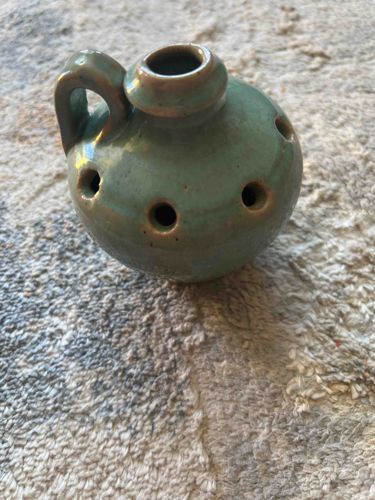
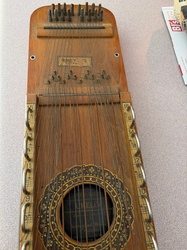
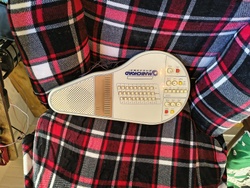
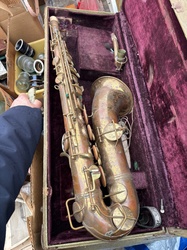
This appears to be a small, spherical ceramic musical instrument, commonly known as an ocarina or a particular type of whistle due to its multiple finger holes and a single mouthpiece. The item has a smooth, glossy glaze with a prominent teal or blue-green color, exhibiting slight variations in tone that suggest a reactive glaze or hand-applied finish. There is a small, curved handle on one side, allowing for a comfortable grip or possibly for attachment to a strap. The mouthpiece is a raised cylindrical opening at the top, surrounded by a subtle brown rim, which is also visible on the interior of the opening and the finger holes, indicating the color of the underlying clay or a secondary glaze. The body features at least five circular finger holes, three visible on the front and two more partially visible on the side, suggesting additional holes not fully captured in the image. The construction appears to be solid and well-fired, with no obvious cracks, chips, or repairs. The surface shows a light patina consistent with handling and use, but no significant damage. Its small size, compact form, and the presence of uniform finger holes indicate it is designed for producing melodic sounds. The craftsmanship suggests it might be a handmade or artisan piece rather than mass-produced, with slight imperfections in the glaze application adding to its unique character. The style is somewhat rustic or folk art-inspired, hinting at an age that could range from mid-20th century to contemporary, given the timeless nature of such ceramic instruments. The quality is good, given the apparent intactness and functional design.
AI Appraisal Report
Upon my virtual examination of this ceramic whistle ocarina, I find it to be in excellent condition. There are no apparent chips, cracks, or repairs, and the glossy teal glaze appears largely intact with a desirable handmade quality. The slight variations in tone and minor imperfections in glaze application suggest it is an artisan-made piece rather than mass-produced, adding to its unique charm. The design, with its multiple finger holes and mouthpiece, confirms its identity as a functional musical instrument. Authenticity, based solely on visual inspection, points strongly towards a genuine ceramic ocarina. However, without handling the item, I cannot confirm its playability, the quality of the sound, or the specific type of clay and firing process used.
In terms of market conditions, ceramic ocarinas of this type, when well-crafted and functional, typically appeal to collectors of folk art instruments, musicians, and those interested in unique ceramic pieces. Comparable items in the current market, often found in craft markets, online artisan shops, or specialty music stores, generally range from $30 to $150 depending on the maker's reputation, complexity, and acoustic quality. This piece falls into a mid-range for such items. Its individual, rustic appeal contributes positively to its demand, though it isn't rare; similar items are produced by many independent potters. The primary factors impacting value here are its excellent visual condition, apparent craftsmanship, and the aesthetic appeal of the glaze.
For a full authentication and more precise valuation, a physical examination would be crucial. This would allow me to assess the acoustic properties (sound quality, tuning), actual material composition, and precise weight. Provenance documentation, though less common for artisan pieces of this nature, could potentially identify the maker and age, which would significantly impact value if it were attributed to a known artist. Scientific testing, such as thermoluminescence dating, would only be considered if there were a strong indication of significant age or historical importance, which is not suggested by the visual evidence alone.