AI Appraisal Estimate

AI-generated estimates · not official valuations

From the user

What was submitted

Photo and notes provided by the user — not generated by AI

Submitted item photo
Submitted photo · May 16, 2026

User's notes

No additional notes provided.

AI analysis below

AI appraisal

AI analysis & estimate

AI-Generated · Verify before acting

Everything below is generated by AI for informational purposes only. AI can make mistakes — the AI may misidentify items or misattribute them (artist, maker, brand, designer, origin, era). This is not an official valuation and should not be used for insurance, sale, tax, estate, legal, or lending purposes — or any decision requiring a certified appraisal. It is not an authoritative claim about any person, brand, or rights holder — do not share or rely on it as a factual statement about a third party. Always consult qualified professionals before making financial decisions.

Read the full disclaimer

AI Identification

·Not independently authenticated·Verify before acting

Eastern Oyster Shell (Crassostrea virginica)

Natural History - Marine Specimens

AI Estimated Value

·Not an official valuation·Verify before acting

$5.00 - $15.00

As of May 16, 2026

AI Item Analysis

·AI can make mistakes·Verify before acting
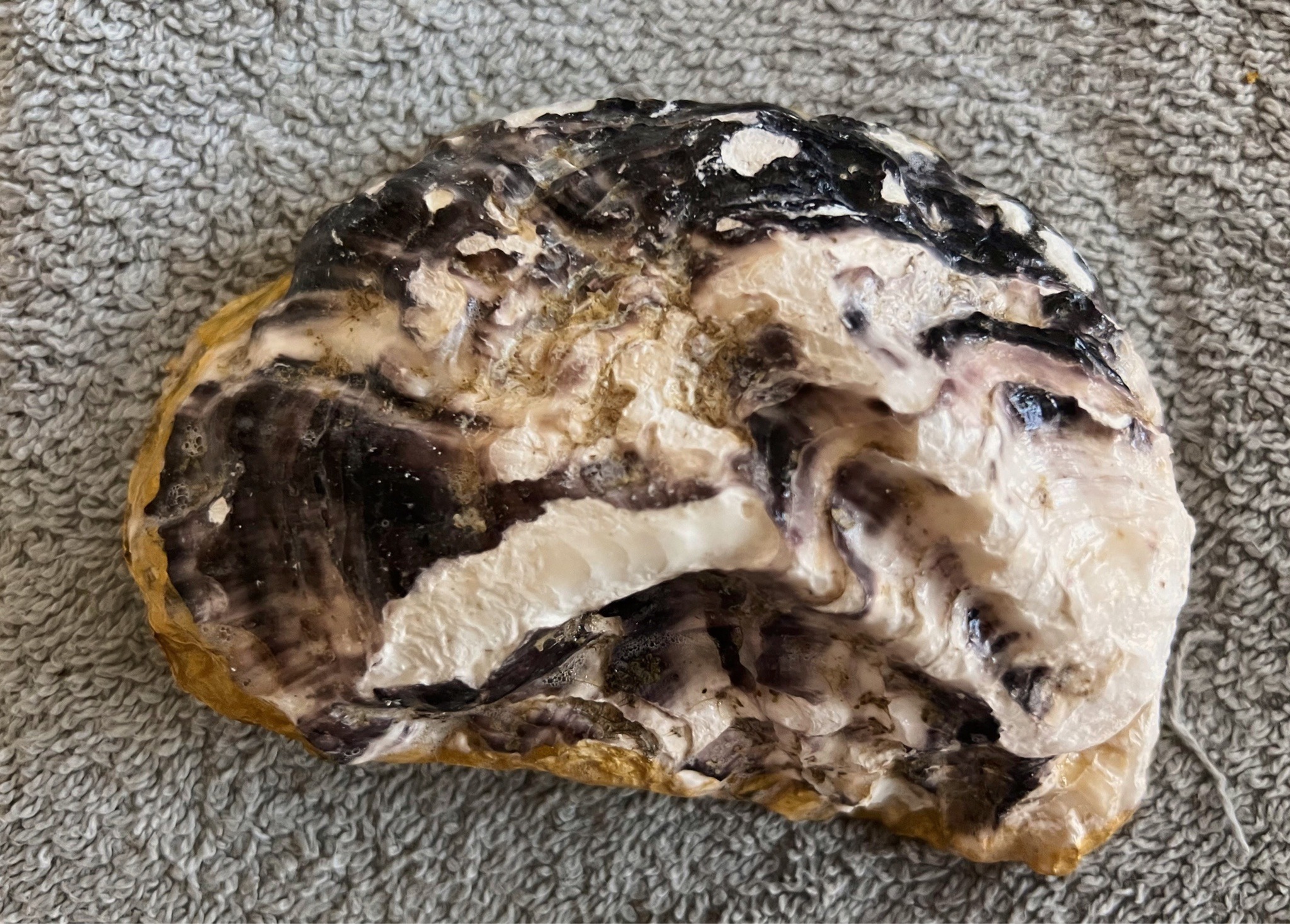
This item is an individual valve of an Eastern Oyster shell, showcasing a highly calcified and irregular structure typical of marine bivalve mollusks. The shell measures approximately four to five inches in length and features a heavily foliated, rugose exterior with dense growth rings. The color palette is a complex mixture of chalky whites, deep purples, and midnight blacks, with some evidence of yellowed mineral staining along the distal edge. The interior surface appears to be a polished nacreous material, though the view is primarily of the outer dorsal area which exhibits significant weathering and calcium carbonate buildup. Notable features include deep concentric ridges and a rough, pitted surface texture indicative of age and environmental exposure. There is visible wear on the edges, consistent with natural surf action or harvesting. Small white deposits on the surface suggest previous attachment of smaller barnacles or lime-scale. The overall construction is thick and heavy, demonstrating high-quality natural calcification and a healthy growth period. This specimen is a natural organic object rather than a manufactured piece, representing a common but well-preserved example of coastal marine life often found along the Atlantic coast of North America.

AI Appraisal Report

·AI can make mistakes·Verify before acting
Based on my visual examination of this individual Eastern Oyster (Crassostrea virginica) valve, I find the specimen to be a common natural history object. The valve exhibits significant foliation and characteristic calcification. The presence of midnight black and purple pigmentation near the muscle scar area, visible even from the dorsal view's depth, confirms its identity. The condition is fair to good for a beach-collected specimen, showing natural weathering and 'bio-fouling' scars from barnacles, though the distal edges show minor chipping consistent with surf action. The market for common oyster shells is saturated. Unlike rare specimens of Spondylus or high-end 'jewelry' grade fossils, modern Eastern Oyster shells are primarily valued as decorative accents, scientific teaching aids, or craft materials. High-quality individuals with exceptional size (over 8 inches) or unique growth mutations can fetch a slight premium, but this 4-5 inch specimen is standard. Comparisons to sold lots on the secondary market show that single valves rarely exceed nominal values unless part of a matched pair or a bulk collection. Critically, as this appraisal is based on photographic evidence, I cannot verify the structural integrity of the calcium carbonate or detect micro-fractures. I cannot definitively rule out modern chemical bleaching or artificial staining without a tactile 'acid test' or UV light inspection. For a full authentication of provenance, documentation regarding the collection site (to ensure compliance with local marine harvesting laws) and a physical weight-to-density analysis would be required to ensure the shell has not become brittle or 'chalky' beyond standard decorative use.

Get your items appraised

Instant estimates of your treasures with AI-powered appraisals

Browse More Appraisals