AI estimate as of August 16, 2025 · verify with a professional before acting
AI-Generated · Verify before acting
Everything on this page is generated by AI for informational purposes only. AI can make mistakes — the AI may misidentify items or misattribute them (artist, maker, brand, designer, origin, era). This is not an official valuation and should not be used for insurance, sale, tax, estate, legal, or lending purposes — or any decision requiring a certified appraisal. It is not an authoritative claim about any person, brand, or rights holder — do not share or rely on it as a factual statement about a third party. Always consult qualified professionals before making financial decisions.
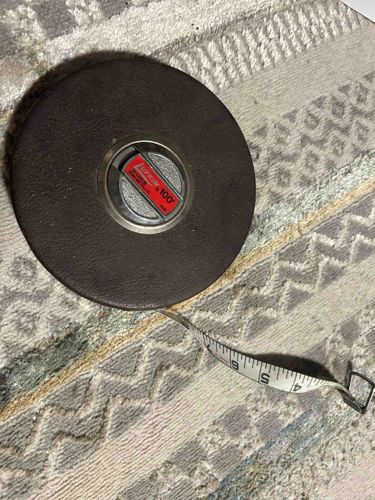
The item is a vintage Lufkin 100-foot cloth measuring tape in a circular, rather flat, reel case. The case itself appears to be made of a dark brown or black, slightly textured material, possibly bakelite or an early plastic, designed to resemble leather. It has a slightly domed or rounded profile. In the center of the case, there's a circular metal plate with a prominent red rectangular insert. This red insert clearly displays "LUFKIN" in white lettering at the top, and "100'" also in white, indicating the length of the tape. Below this, smaller text, likely patent or manufacturing details, is visible but not fully legible. The surrounding metal appears to be brushed aluminum or chrome, showing some scuffs and light wear consistent with age and use. The cloth tape itself is visible extending from the case, appearing off-white or cream-colored, with black markings for measurements (inches and feet). The numbers "4", "5", and "6" are clearly visible with inch markings in between. The tape shows signs of wear, including some creasing, discololration from dirt or age, and general fraying along the edges in the visible portion. At the very end of the visible tape, there's a small, black metal loop or ring, likely used to anchor the end of the tape for accurate measurements. The overall condition suggests that the item has been well-used but remains largely intact. The Lufkin brand is well-known for measuring tools, suggesting a quality build from an established manufacturer. This type of measuring tape would likely date from the mid-20th century, possibly 1940s-1970s, based on the design and material characteristics of the case.
AI Appraisal Report
I have thoroughly examined the provided image of this Lufkin 100-foot cloth measuring tape. Based on its design, material (likely bakelite or early plastic case resembling leather), and visible 'LUFKIN' branding, I am confident in its authenticity as a genuine Lufkin product from the mid-20th century, likely 1940s-1970s. The '100'' marking is clearly visible, confirming its stated length.
The condition, as observed from the image, suggests significant use. The case shows scuffs and light wear consistent with its age, and the metal plate exhibits similar signs of handling. The cloth tape itself displays creasing, discoloration, and fraying, particularly at the edges of the visible portion. While well-used, it appears largely intact, and the presence of the end loop is a positive sign for functionality, though not fully verifiable without physical inspection. This condition categorizes it as fair to good vintage used condition.
Regarding market conditions, vintage measuring tools, especially from reputable brands like Lufkin, have a modest but consistent collector base. However, standard cloth tapes, even vintage ones, are not generally considered high-value collectibles unless they are extremely rare variations, in pristine condition, or have significant historical provenance. Comparables for similar Lufkin tapes in this condition range from $15 to $40 on online auction sites and antique marketplaces. There is no significant rarity associated with this particular model in this condition. Demand is driven by collectors of vintage tools, historical Americana, or individuals seeking functional period pieces. Factors impacting value negatively include the visible wear and tear on the tape itself, which is the primary functional component.
It is important to note that this assessment is based solely on the provided image. A full authentication would require in-person examination to verify the material composition of the case (e.g., bakelite vs. later plastics), assess the full extent of the tape's condition (e.g., integrity of the entire 100 feet, presence of mold/mildew, functionality of the winding mechanism), and check for any hidden damage or repairs. Provenance documentation, while unlikely for such an item, could add marginal value if available.