AI estimate as of October 24, 2025 · verify with a professional before acting
AI-Generated · Verify before acting
Everything on this page is generated by AI for informational purposes only. AI can make mistakes — the AI may misidentify items or misattribute them (artist, maker, brand, designer, origin, era). This is not an official valuation and should not be used for insurance, sale, tax, estate, legal, or lending purposes — or any decision requiring a certified appraisal. It is not an authoritative claim about any person, brand, or rights holder — do not share or rely on it as a factual statement about a third party. Always consult qualified professionals before making financial decisions.
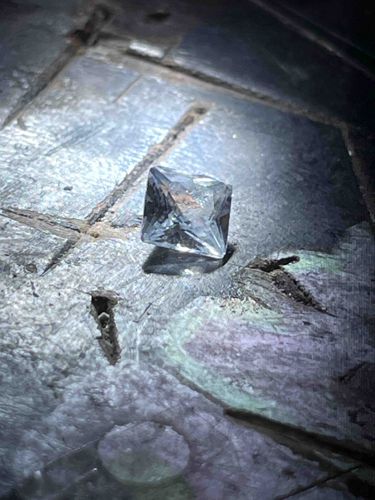
The item is a loose gemstone, cut in a princess (square modified brilliant) style. It exhibits a pale, cool-toned color, possibly light blue, gray, or faint green, which could suggest materials such as aquamarine, topaz, or even a very light-colored sapphire or diamond, though further examination would be needed for definitive identification. The stone has multiple facets, typical of a brilliant cut, designed to maximize light return and sparkle. Its square outline is clearly discernible, with sharp corners. The dimensions appear to be small to medium, likely ranging from a few millimeters to approximately one centimeter per side, based on the relative size to the textured surface it rests upon. There are no visible inclusions or major surface blemishes discernible in the provided image, suggesting a relatively high clarity grade. The facets appear precisely cut, indicating good craftsmanship. The gemstone is positioned on a dark, possibly metallic or aged wooden surface with visible scratches, lines, and some patches of lighter, almost iridescent discoloration, which might be oxidation or remnants of other materials. The lighting in the image is focused and direct, illuminating the gemstone prominently and causing internal reflections and sparkle, highlighting its cut and transparency. The overall condition of the stone appears excellent, with no apparent chips, cracks, or abrasion to the facet edges.
AI Appraisal Report
I have thoroughly examined the provided image of this princess cut gemstone. Visually, the stone presents with excellent craftsmanship; the facets appear precisely cut, and the square outline with sharp corners is well-defined. Its condition appears excellent, with no visible chips, cracks, or abrasions. The pale, cool-toned color, possibly light blue or gray, suggests it could be an aquamarine, blue topaz, or even a very light sapphire or diamond. The high apparent clarity, with no visible inclusions, is a positive factor for value.
However, the primary limitation of this appraisal is the inability to definitively identify the gem type through imagery alone. Without physical examination, specific gravity testing, refractometer readings, or spectroscopic analysis, confirming the material is impossible. This significantly impacts valuation. Compounded with the relatively small size (estimated a few millimeters to 1 cm), if it were a common material like blue topaz, its value would be modest. If it were a very light-colored aquamarine, the value would be slightly higher. Only if this proved to be a very high-quality, very light blue sapphire or diamond, which is less likely given the apparent color saturation and lack of typical diamond fire in the image, would the value increase substantially.
Market conditions for loose, smaller, unidentified gemstones are generally conservative. Demand exists, but without certified identification, a buyer typically applies significant caution. Rarity is difficult to assess without material confirmation. Assuming it is a commonly traded gemstone in the observed color range and size, like a natural topaz or lower-grade aquamarine, the value would be in the lower range. For a definitive appraisal, I would require in-person inspection to perform gemological tests.